
Multi-agent coordination in interceptor drone systems: what real-world autonomy actually looks like
Swarm interception isn't the textbook triangle. It's shared state, trajectory recalculation under uncertainty, and software that keeps the system coherent when reality stops being convenient. A field view from production engineering on interceptor platforms.
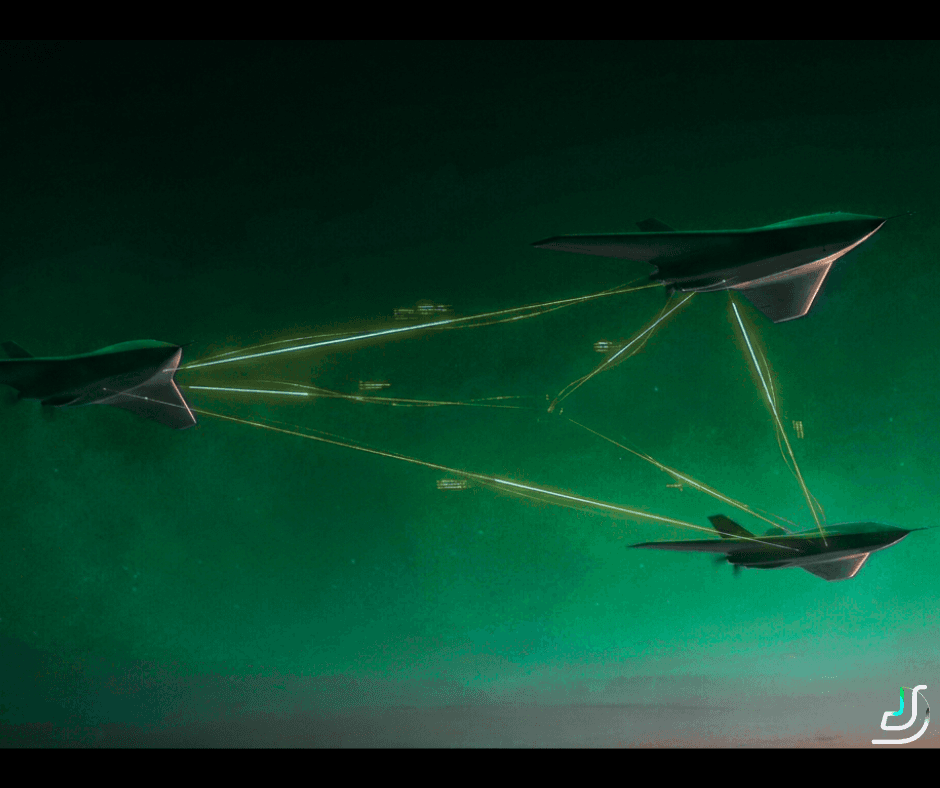
People still imagine swarm interception like a textbook diagram — several drones, a target in the middle, a "triangle," and a synchronized attack. In reality, it's much more interesting than that.
One drone may detect and lock the target first. It then shares the target state with the others, and each vehicle recalculates its own trajectory in real time based on its position, the target's speed, latency, data quality, and how much confidence the system actually has in the current track.
That's where the real engineering begins. Because the problem is no longer just about seeing the target. The problem is making sure several agents can keep acting coherently when:
- some of the data arrives late
- the video feed is noisy
- the link is imperfect
- the track gets stale faster than you'd like
- and the target is already moving differently than the system expected a second ago
Moments like this make one thing very clear: autonomy is not about a nice animation on a slide. It's about shared state, trajectory updates, robustness to bad data, and the ability of the system to keep functioning when reality stops being convenient.
Here, software is no longer just "supporting the hardware." Here, software is the logic that determines whether the system stays coherent at all.
This is the view from inside production work on interceptor platforms — what the engineering actually looks like once you strip the marketing layer off. It's also why a defense engagement on this kind of system is structured very differently from a typical AI/ML project.
Why the "triangle" model breaks immediately
Most public discussion of drone swarm interception assumes a clean geometry — agents arranged around a target, a synchronized convergence, predictable kinetics. That model is useful for explaining concepts and useless for engineering systems.
The actual conditions an interceptor swarm operates under:
- Asynchronous detection. One agent locks the target first. The others learn about it from the network, not from their own sensors. Their perception of the target is several frames stale before they even start reacting.
- Heterogeneous information quality. The detecting agent has high-confidence track data. Receiving agents have whatever survived the link — possibly compressed, possibly delayed, possibly partial.
- Per-agent kinematic constraints. Each vehicle is at a different position, energy state, and orientation. The "optimal" trajectory from a planner's perspective is not the same as what any single agent can actually execute.
- Adversarial target behavior. The target is not a cooperative point in space. It maneuvers, sometimes specifically to defeat tracking.
- Degrading link conditions. The communication channel between agents is the first thing the environment attacks — RF clutter, range, terrain, deliberate jamming.
The triangle diagram assumes none of this is happening. The production system has to assume all of it is happening, all the time.
What "shared state" actually means in flight
The phrase "shared state across agents" sounds clean and is anything but. In practice it's a distributed systems problem with hard real-time constraints, partial failure as the default, and no graceful degradation to a single source of truth.
The state being shared is not a single object — it's at minimum:
- Latest target track (position, velocity, covariance, age)
- Track confidence and the basis for that confidence (own sensor / received / fused)
- Each agent's own state (position, velocity, energy, intent)
- Group-level decisions in progress (who is engaging, who is repositioning, who is providing observation)
- Recent network health (which links are live, which are intermittent)
Every agent maintains its own view of this state. The views are never perfectly synchronized — they can't be, the physics of the link don't allow it. What the system has to guarantee is that they're synchronized enough that coherent action is possible.
"Enough" is doing a lot of work in that sentence. Concretely it means: the divergence between agents' views stays bounded under expected link conditions, and when it doesn't, the system detects this and falls back to safe behavior rather than uncoordinated action.
Trajectory recalculation under uncertainty
The naive control loop is: receive target state, compute intercept trajectory, execute. The production loop is closer to: receive partial target state, estimate confidence, decide whether to act on this update or wait, recalculate own trajectory accounting for what the other agents are probably doing right now, execute the next short segment, repeat.
Each agent is recalculating constantly because each input to the calculation is in motion:
- The target's actual position has changed since the data was captured (sensor latency)
- The target's predicted trajectory may be invalidated by new behavior (maneuver)
- The agent's own state has changed since the last cycle
- The other agents' implicit commitments — who is going where — may have changed
- The network estimate of "what the group is doing" may be stale
The mathematical machinery is mostly standard — extended Kalman filters, model predictive control, multi-agent assignment algorithms, consensus protocols. The hard engineering is not in the math. It's in deciding what to do when the inputs to the math are unreliable, late, or contradictory, and the deadline is now.
When the video feed is noisy
Computer vision on flying platforms is its own subproblem and we've written about it elsewhere. For interceptor coordination specifically, the relevant property of CV is that the input to the rest of the system — the target track — has variable quality and the rest of the system has to know how variable.
A few situations that matter:
- Track loss and reacquisition. The detector loses lock for a second, then reacquires. To the coordination layer this looks like a discontinuity in target state. Bad handling: each agent treats the gap differently and the group's collective track drifts. Good handling: track confidence drops smoothly during the gap, agents continue on last-known trajectory, group decision-making accounts for degraded confidence.
- False positives and identity confusion. Especially in cluttered environments with multiple plausible targets, the detector may produce confident-incorrect tracks. The coordination layer has to be robust to receiving "the wrong target" as a high-confidence update without immediately committing the group to it.
- Sensor disagreement between agents. Different agents see the same target from different angles, under different lighting, with different motion blur. Their independent tracks won't agree. The system has to fuse these views without averaging away real information.
The pattern in all three cases is the same: the coordination layer treats the perception layer's output as a noisy signal with a known noise model, not as ground truth. This is straightforward to say and hard to engineer correctly, because it requires every decision in the system to be uncertainty-aware rather than threshold-based.
When the link is imperfect
The communication layer between agents is where every clean architecture meets the real world. The expectations from textbook distributed systems — reliable delivery, bounded latency, consistent ordering — none of them hold.
What actually happens to a message between two agents in flight:
- It may not arrive
- It may arrive late
- It may arrive out of order relative to other messages from the same sender
- It may arrive after a state update has made it obsolete
- It may arrive to some recipients in the group and not others
This is not exotic — it's the default condition. Mesh networking helps, store-and-forward helps, back-pressure helps, but none of these eliminate the underlying behavior. They convert it from "the system breaks" to "the system degrades gracefully."
The coordination layer has to be designed assuming partial information at all times. Every decision has to be reasonable given what each agent currently knows, not given what the group collectively knows in some imaginary synchronized state.
This shapes the architecture in ways that look strange to engineers coming from data-center distributed systems. There's much less reliance on global consensus. More reliance on local decisions with bounded divergence. More reliance on each agent having a defensible default behavior when the network goes quiet.
When the track gets stale
There's a deadline on every piece of information in the system. A target track captured 200ms ago describes a world that no longer exists. The faster the target and the longer the interception arc, the more aggressively this matters.
The system has to know, at every decision point:
- How old is the data this decision is based on?
- How much could the world have changed since?
- Is this decision still safe given that uncertainty?
Practically this means age and confidence are first-class properties on every shared state object, and the decision-making logic explicitly accounts for them rather than treating "we received this" as "we know this." The cost of getting this wrong isn't a slightly suboptimal intercept — it's the group committing to a trajectory based on stale information and missing entirely.
When the target moves differently than expected
Target behavior modeling is the part of the problem where the engineering is most explicitly adversarial. Cooperative motion models — constant velocity, constant acceleration, simple maneuvers — work for benign targets. They don't survive contact with a target that's actively trying to defeat tracking.
The honest engineering position is: the prediction model will be wrong, sometimes badly. The system has to detect that the model is wrong fast enough to recover. This means:
- Tracking prediction error as a first-class signal, not just an internal diagnostic
- Switching models when error exceeds expected bounds, rather than continuing to feed bad predictions into the controller
- Falling back to shorter prediction horizons when confidence in target behavior is low
- Communicating reduced confidence to the rest of the group so collective decisions account for it
This is one of the places where the difference between research-grade autonomy and production-grade autonomy is most visible. Research code optimizes for the expected case. Production code spends most of its complexity on what happens when the expected case doesn't hold.
What this means for the software stack
The architectural implications stack up:
- The state representation has to carry uncertainty, age, and provenance for every piece of data, on every agent, all the time.
- The communication layer has to be designed for partial delivery as the default, not as an error condition.
- The decision-making logic has to be uncertainty-aware end to end. There is no "trusted layer" where you can pretend the inputs are clean.
- The perception layer has to expose its confidence and failure modes to downstream logic, not paper over them.
- The control layer has to be tolerant of trajectory updates that arrive late or get superseded.
- The whole system needs a defensible answer to "what does each agent do when the network goes quiet."
None of these are exotic individually. The challenge is that they all have to be true simultaneously, in real time, on power-constrained hardware, in environments that are actively hostile to the assumptions the system depends on.
This is what we mean when we say software is the logic that determines whether the system stays coherent. The hardware is a precondition. The software is the system.
How we work on this kind of project
Defense engagements at this layer don't look like typical AI/ML consulting work. A few things that are structurally different:
- NDA before specifics. We can describe capability domains publicly. Client identities, specific architectures, and operational details stay under NDA. Mutual NDA in 24 hours for serious conversations.
- Engineering pods, not staff augmentation. Defense work is shipped by tenured engineers — typically 5+ years inside the company, with the autonomy and accountability of a small team rather than individual contractors slotted into someone else's stack.
- Allied / dual-use focus. Our defense work is in the allied and dual-use space. We're not pursuing US-pure-ITAR programs. Operating in this category is a deliberate fit choice based on the team's actual position and capabilities.
- Operational track from 2022. The team has been delivering CV training for interceptor drones and mesh networking for drone group resilience continuously since 2022. The work described in this article is current engagement context, not adjacent capability.
For the broader picture of what we ship in this space, see /industries/defense-tech. For an overview of our engineering approach to AI systems generally, /services/ai-genai.
If you're working on multi-agent coordination, perception under adversarial conditions, or any system where "shared state across agents under degraded conditions" is the actual problem — that's our zone. The fastest way to find out if it's a fit is a 45-minute scoping call at justsoftlab.com/contact. Engineers on the call, not account managers. We'll know within those 45 minutes whether the problem is in our wheelhouse.
Talk to the team behind this
Building something like this in production?
Our senior engineers ship this kind of work for real teams. 45-minute call, no pitch deck — just architecture, trade-offs, and whether we're the right fit for your problem.