
How much does AI agent development cost?
Honest engineering-led breakdown of what AI agent development actually costs in 2026 — by intelligence tier, scope, and compliance load. With cost ranges from five real engagements and where production budgets actually go.
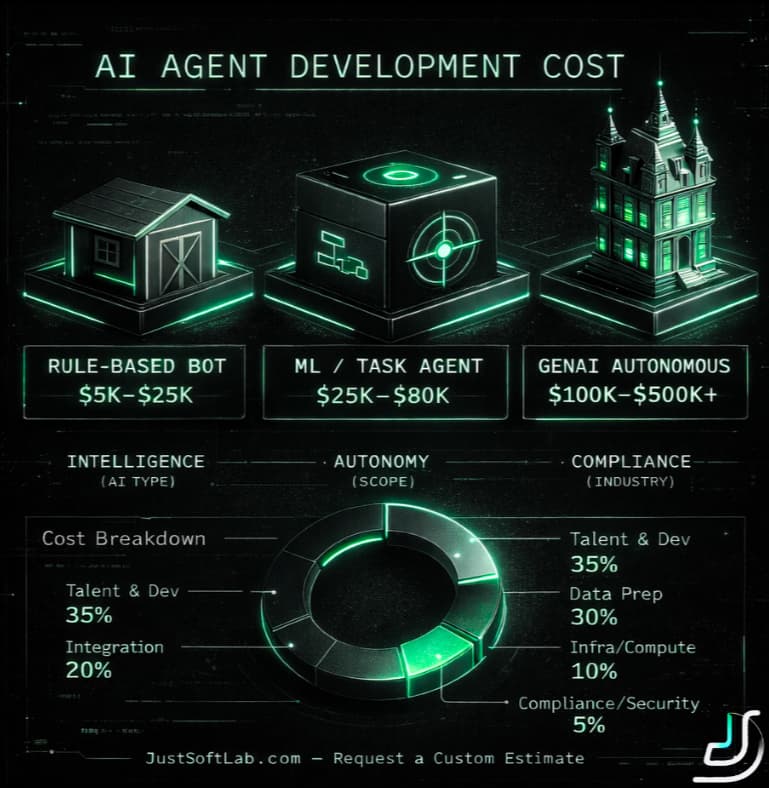
"How much does an AI agent cost?" is the wrong first question. The honest answer always starts with another one: what do you actually mean by "agent"? A scripted FAQ bot, an LLM that answers from your documents, and a system that logs into your ERP and reroutes a shipment without human approval — these are three completely different builds, and the cost spread between them is two orders of magnitude.
Most pricing confusion in AI agent projects comes from this mismatch — buyers planning for a $40K chatbot end up scoping a $400K autonomous system, or the reverse. So before any number is meaningful, the bands have to be straight.
Rough cost bands we see in production:
- Rule-based / scripted bots — $5K to $40K. Good for FAQs, fixed workflows, deterministic decision trees. No LLM in the loop, or LLM only as a thin paraphrase layer.
- ML or LLM-assisted agents on a narrow workflow — $25K to $150K. Trained for a specific task, integrates with one or two systems, has limited autonomy.
- Autonomous GenAI agents that plan multi-step work and execute against business systems — $100K to $500K+ for the initial build, plus 15–20% annually for retraining and drift.
- Compliance overhead — add 25–40% on top of any of the above for HIPAA, GDPR, SOX, PCI-DSS, or SR 11-7 environments.
Below: how those numbers break down, where teams overspend, and what we actually quote on real engagements.
The three levers that move the price
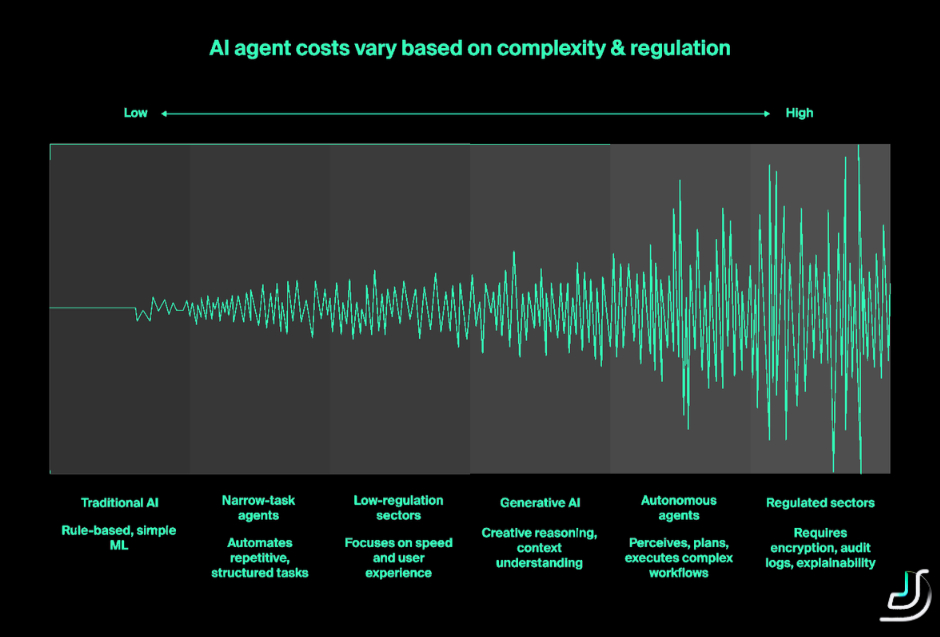
Three variables explain almost every cost gap we see between engagements. Get them right, and the budget converges on a defensible number. Get any one wrong, and you're either underbuilding for the actual workload or paying for capability you don't need.
1. Type of intelligence
This is the biggest single lever. It determines whether the team is writing logic or shipping a learning system.
Rule-based and classical ML. Deterministic logic, decision trees, classical classifiers on structured data. Everything is predictable, testable, and cheap to operate. No GPU bill, no foundation-model dependency, no prompt engineering. Costs land in the $5K–$60K range depending on integration scope. The trade-off is rigidity: any case the rules don't cover requires a rule update.
Generative AI — LLMs, small language models, multimodal stacks. These can read context, handle vague instructions, and generalize beyond their training set. They also bring a real cost profile: data preparation, evaluation harnesses, GPU inference, and engineering talent that's currently among the most expensive in tech. Custom GenAI builds typically start at $50K and routinely cross $500K for production deployments.
The honest reality: almost no fintech or healthcare client should be training a foundation model from scratch. That's a $100M+ exercise reserved for OpenAI, Anthropic, Google, and a handful of state-funded labs. What real engagements do is fine-tune existing models (Claude, GPT, Llama, Mistral) and wrap them in retrieval, evaluation, and orchestration layers. The cost driver isn't the model — it's the system around it.
2. Scope of autonomy
The second lever is what the agent is actually allowed to do. Cost scales non-linearly with the number of decisions and integration points.
Narrow-task agents are the dependable workhorses — they automate a single workflow, integrate with one or two systems, and operate on a deterministic happy path with a small number of branches. Built on RPA/IPA platforms (WorkFusion, Power Automate, n8n) or lightweight orchestration, they ship fast and stay in budget: $10K–$60K is typical, with the upper end driven by integration complexity, not intelligence.
End-to-end autonomous agents are a different class of build. They plan, reason across multiple steps, hold context across long-running interactions, and self-correct when a step fails. Imagine an insurance agent that intakes a claim, validates policy coverage in a legacy database, runs damage photos through computer vision, calculates a payout, and drafts a settlement — all without a human in the loop. This is real engineering, built on orchestration frameworks like LangGraph, CrewAI, or Microsoft AutoGen. MVPs start at $100K. Enterprise-grade systems with multiple integrations and audit-grade observability run $500K+.
The initial build is rarely the full cost. Autonomous agents need an evaluation harness (golden sets, hallucination metrics, refusal-rate tracking), continuous monitoring, and human-in-the-loop checkpoints during the early operating period. Skip those and you'll pay later in support tickets, regulatory fines, or quiet model drift.
3. Industry compliance
Where the agent is deployed matters as much as what it does. Compliance overhead is the multiplier most cost estimates miss.
In regulated industries — healthcare under HIPAA, finance under PCI-DSS / SR 11-7 / DORA, life sciences under 21 CFR Part 11, EU deployments under the AI Act — every architectural decision carries a compliance cost. Encryption with customer-managed keys, role-based access on retrieval, audit logs that join model output to user identity and timestamp, explainability layers for adverse-action notices, model risk reviews — none of this is optional.
Independent estimates put compliance overhead at 17% to 40% of total AI development cost in high-risk sectors. Our own engagements track in that range, with the upper end common in healthcare and banking — a triage assistant that's $30K of pure engineering becomes $45K–$60K once HIPAA controls are in place. For deep treatment of how this plays out specifically in fintech RAG, see our reference architecture for production-grade RAG in regulated finance.
In low-regulation sectors — eCommerce, media, education — the engineering focus shifts from legal defensibility to performance and personalization. Prices generally land in the mid-range: $25K–$60K for a solid recommendation or tutoring agent.
Where the money actually goes
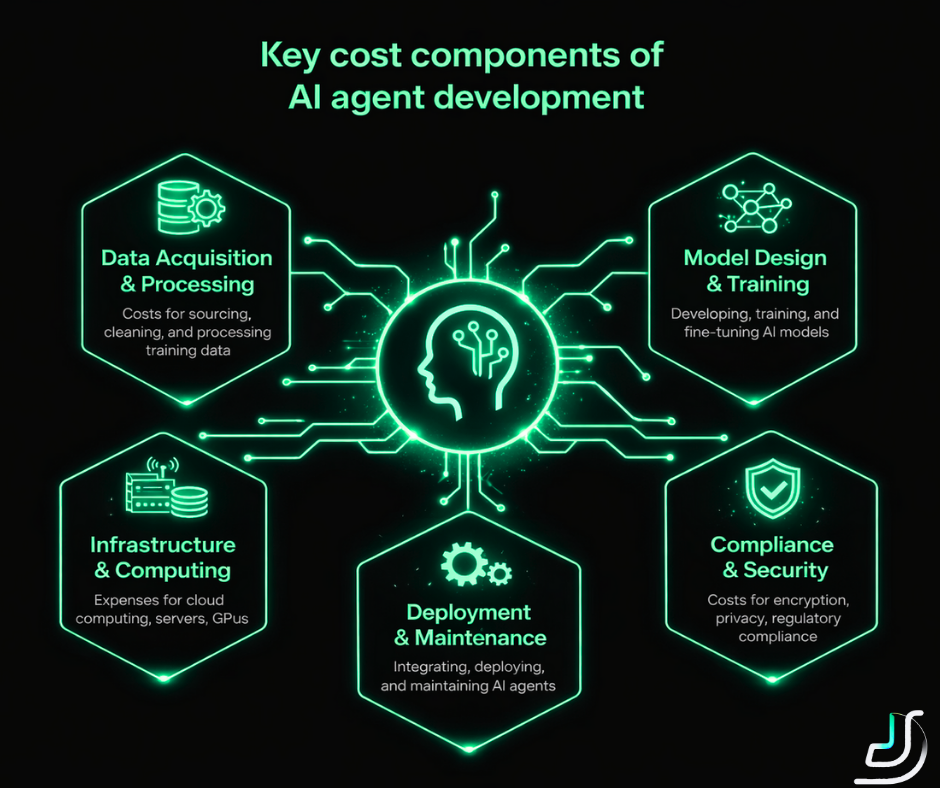
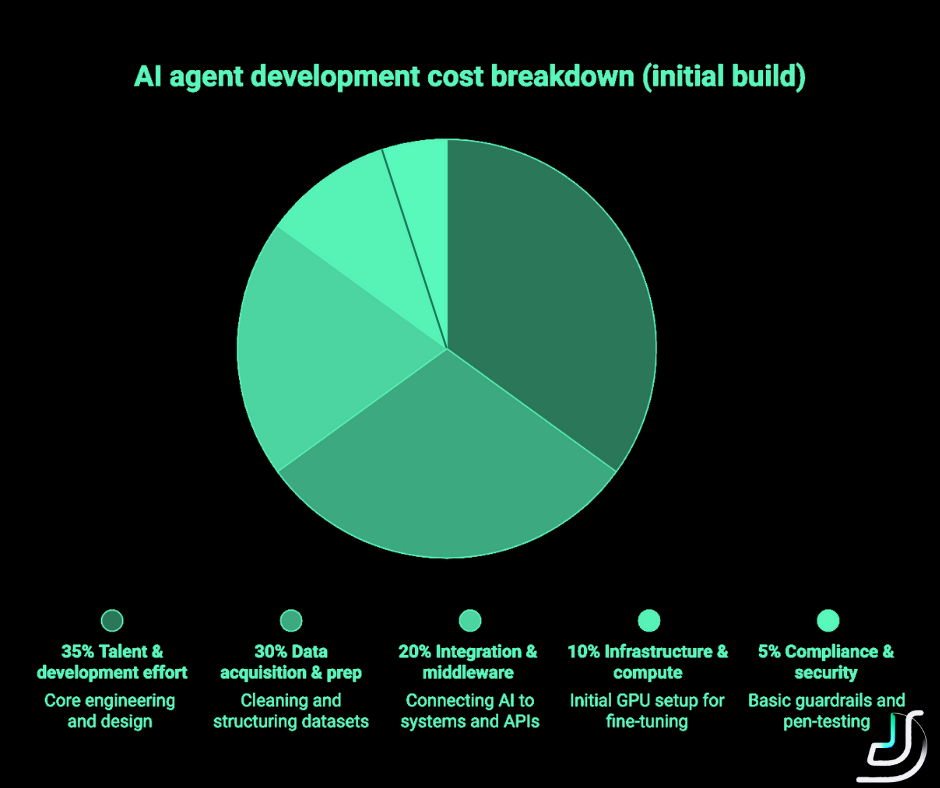
When we quote an AI agent project, the line items rarely match the "build a model" mental model that buyers come in with. Here's how production budgets actually distribute, based on the engagements we've shipped.
Discovery and architecture (~5%). Before any code, the team spends 1–2 weeks on data audit, integration surface mapping, regulatory scoping, and architectural choice. This is the cheapest phase to move on, and the most expensive to skip — almost every cost overrun we see traces back to a discovery shortcut.
Engineering effort (~30–35%). Architecture design, prompt engineering, retrieval and orchestration code, evaluation harnesses, integration adapters. AI engineers are among the most-paid talent in tech right now, which is why this line item dominates. Many clients work with AI development partners instead of hiring in — fixed project cost, ramped team, no full-time burden once the system stabilizes.
Data preparation (~20–30%). Algorithms are commodities. The data they're trained or grounded on is the asset. Collecting, cleaning, labeling, deduplicating, and structuring source data routinely consumes a quarter of the budget. With unstructured corpora — PDFs, scanned forms, transcripts — the percentage climbs higher. Data prep gets cut first by inexperienced teams, and pays for that cut throughout the rest of the project.
Integration and middleware (~15–20%). The "last mile" connecting the agent to ERPs, CRMs, ticketing systems, payment processors. LLMs are brains in jars; without robust adapters, authentication, and idempotency handling, the agent can talk about work but can't actually do it. This is where ambitious autonomous-agent projects most often stall.
Evaluation, safety, human-in-loop (~10%). Golden-set evaluation, hallucination metrics, refusal-rate tracking, bias testing, HITL workflows during the early operating period. In regulated industries this is non-negotiable. In any production agent, skipping it is the most expensive false economy on the list.
Infrastructure and compute (~5–10%). GPU costs for fine-tuning, inference, and self-hosted inference if applicable. The percentage looks small at MVP scale but grows quickly with traffic — by month three of production, infrastructure can be the largest variable line item. On-prem hardware (NVIDIA H100 racks) shifts this from variable cloud spend to capital expense, but doesn't eliminate it.
Compliance and security (~5%, multiplied by industry). For commercial deployments, baseline guardrails and pen-testing. In regulated industries the multiplier kicks in — audits, attestations, model interpretability work, legal review. The 25–40% overhead above is largely concentrated here.
Year-2 maintenance (separate budget line). Production AI is not a one-time build. Models drift as customer behavior and data patterns shift. Source documents change. Compliance frameworks evolve. Budget 15–20% of the initial development cost annually for retraining, prompt and retrieval tuning, and ongoing monitoring.
Five engagements that priced out differently
To anchor the abstractions, here's how five real AI agent builds — two from market leaders, three from the JustSoftLab portfolio — actually priced out. Cost ranges reflect the level of autonomy and integration each project required.
Drift (Salesloft) — sales and support platform. Drift handles high-volume, low-complexity sales and support interactions: lead qualification, scheduling, basic Q&A. Built on NLP and rule-based logic, it's a focused agent that doesn't operate outside its domain. Custom builds in this category typically run $50K–$200K depending on integration depth.
Amelia — enterprise digital workforce. Amelia lets enterprises build "digital employees" that handle complex IT and HR workflows, integrating deeply into legacy systems and executing tasks autonomously. Full deployments are major undertakings: $500K–$5M is common, driven mostly by configuration, integration, and platform licensing.
GenAI customer intelligence agent for a global haircare brand. We built an agent that unifies customer feedback from Sephora, Trustpilot, and other scattered sources for a global beauty leader. The system uses Snowflake Cortex AI and Streamlit to automate sentiment analysis and persona segmentation, replacing roughly 60 hours of manual analyst work per month. Because the build leveraged existing data infrastructure for a rapid PoC, it landed in the $35K–$60K range.
Lyric Aria — GenAI tutor for music education. As R&D, we built an agentic music learning platform on Google Cloud (Vertex AI, Gemini 2.5). The system ingests raw text and dynamically generates personalized course curricula, quizzes, and cover art via Imagen3. A self-reflecting agent combines RAG with live web search to answer student questions in real time. MVP-scale builds of comparable scope are $45K–$80K.
GenAI sales training platform with RAG. A scalable solution for onboarding sales managers, built on a flexible RAG architecture using GPT-4 and Mistral 7B. The platform ingests internal materials (PDFs, videos, transcripts) and automatically creates tailored courses, with adaptive chunking and few-shot patterns to suppress hallucinations. The deployment cut new-hire ramp-up from six months to two weeks. Core engine builds run $80K–$150K. The retrieval and ranking patterns we used here mirror what we describe in our pgvector vs Pinecone production benchmark.
Where teams overspend (and how to scope down)
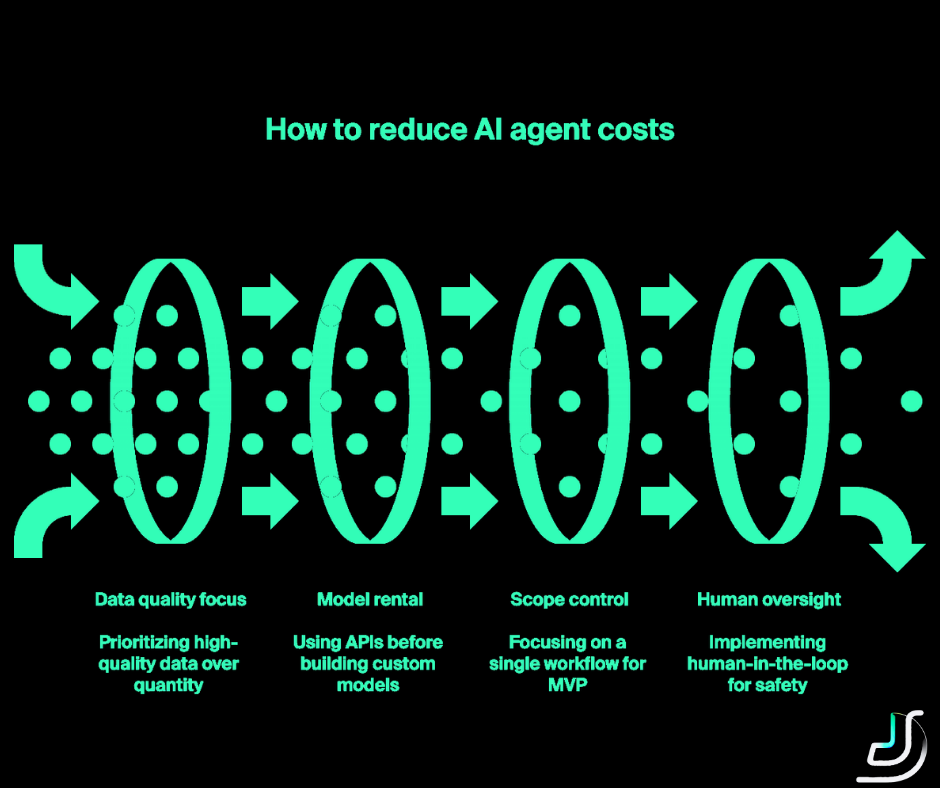
Across dozens of AI agent engagements, the same four cost traps recur. None require world-class engineering to avoid — they require disciplined scoping.
Over-curating data. Many teams burn months trying to clean every legacy log, on the assumption that more data equals better AI. It doesn't. A small, well-curated dataset routinely outperforms a noisy massive one for fine-tuning and retrieval. Synthetic data and semi-supervised labeling fill gaps without expanding payroll. Spend the data-prep budget on representative quality, not exhaustive coverage.
Building when renting works. Launching with a custom-trained model is the fastest path to cloud bill shock. For MVPs and early production, use foundation-model APIs (Anthropic, OpenAI, Voyage for embeddings) and validate the business case on OpEx. Move to model distillation or self-hosted small language models only after traffic patterns are stable and the unit economics justify the operational lift.
Big-bang scoping. The most expensive failure mode is integration hell — an agent that works in the lab but can't navigate a 20-year-old ERP. Avoid the Big Bang launch. Build for one specific workflow first (password reset, single claim type, single product line) and prove the integration patterns at small scope. Identify the gaps when they're cheap to fix, not after you've spent six figures on broad-scope custom development.
Skipping human-in-the-loop in early production. Fixing a hallucinating or biased agent after deployment is dramatically more expensive than catching it during the early operating period. In regulated sectors, a rogue agent isn't just embarrassing — it's a compliance fine in waiting. Bake HITL into the launch budget: AI drafts, human approves during the early phase, with rigorous bias testing and golden-set evaluation throughout.
The point isn't to spend less. It's to spend right. A $10K bot that saves a support team hours per week is well-priced. A $500K enterprise agent that transforms supply-chain logic and recovers millions in efficiency is well-priced. The cost is determined by the value, not by the sticker — but the architecture, scoping, and discipline determine whether the value actually materializes.
How to estimate without a sales call
For typical scopes, you can get a deterministic ballpark in about ten minutes through our Project Estimator — a six-step wizard that produces a PDF you can take to procurement without a discovery call first. The engine encodes the cost factors above (intelligence tier, scope, regulatory environment, integration count) and outputs a defensible range based on real engagement data.
For ambitious autonomous-agent builds in regulated industries — fintech RAG, healthcare AI, autonomous workflows touching financial systems — the estimator gives you a starting point, but the right next step is a 45-minute Discovery call with our AI engineers. We'll review your data, your integration surface, and your regulatory constraints, and tell you honestly what the architecture needs to look like — including where we'd say no to scope that doesn't pencil.
AI agent development cost FAQs
How much does it cost to build an AI agent? There's no single price tag, but the bands are clear. A rule-based bot for internal FAQs runs $5K–$25K. A specialized ML agent for retail, media, or education is $25K–$80K. Enterprise-grade autonomous agents that plan workflows, execute transactions, and integrate with legacy systems start at $100K and scale past $500K. Autonomy and compliance load are the two biggest cost drivers.
How do I control costs when scaling AI agents? Scaling triggers bill shock when you rely entirely on per-token foundation-model APIs. Use a distillation strategy — start with a powerful expensive model to validate the MVP, then transition to smaller open-source models (Llama 3, Mistral, Phi) hosted on your own infrastructure for high-volume tasks. Cache deterministically answerable queries so the model doesn't re-think the same question. The architectural goal is to convert unpredictable variable cost into predictable fixed cost.
AI agent vs human agent — which is more cost-effective? A $50K AI agent build looks expensive next to one human-agent salary, but the long-term economics rarely favor the human. Human contact-center agents cost roughly $1.35 per contact and are bounded by shift length, burnout, and seasonal staffing pain. Production AI agents cost cents per interaction, run 24/7, and absorb traffic spikes without overtime. For high-volume support workloads, AI doesn't just replace cost — it recovers revenue lost to long wait times. The honest framing is "where do we use each well," not "which one wins."
What are the hidden costs of enterprise AI agent implementation? Three places budgets routinely overrun. Data preparation — cleaning legacy data can consume 30% of the budget by itself. Change management — training staff to work alongside the AI. And the compliance tax — audits, encryption, bias testing, model risk reviews, which can add 25–40% in regulated industries. Plus year-2 maintenance: 15–20% of the initial budget annually for retraining, prompt tuning, and observability.
Can I use off-the-shelf AI agents to save money? Yes, with caveats. Off-the-shelf platforms (generic support bots, scheduling assistants) have low monthly fees and zero development time — they're correct for standard tasks. They fail at workflows specific to your business: "check inventory in SAP, then email the warehouse manager when stock dips below threshold." If your competitive advantage depends on a unique process, custom builds give better long-run ROI because they adapt to your business instead of forcing the reverse.
Ready to scope a real number? Run the Project Estimator for a deterministic ballpark, or book a 45-minute Discovery with our AI engineers if your scope crosses regulated data or autonomous decision-making.
Talk to the team behind this
Building something like this in production?
Our senior engineers ship this kind of work for real teams. 45-minute call, no pitch deck — just architecture, trade-offs, and whether we're the right fit for your problem.