
Few-shot learning: how AI learns faster with less data
Few-shot learning is a production-friendly LLM technique that adapts models to new tasks with a handful of examples — not a separate ML approach. What it is, when to use it, and where it ships in production.

Few-shot learning isn't a new ML approach — it's a production-friendly LLM technique that adapts models to new tasks with a handful of examples instead of expensive retraining. The honest framing: when you need a model to handle a new task and you have 2-50 high-quality examples, few-shot prompting often delivers better results than fine-tuning, and ships in hours instead of weeks.
Traditional ML approaches require large labeled datasets — gathering, cleaning, and annotating thousands of examples is expensive, time-consuming, and sometimes impossible due to data scarcity or privacy restrictions. Few-shot learning sidesteps this constraint, making it one of the most practical techniques for enterprise AI deployment in 2026. 88% of C-level decision-makers want to accelerate AI adoption in 2025, but only a fraction of AI initiatives deliver expected ROI. Few-shot learning addresses one of the biggest blockers: data scarcity.
This article maps what few-shot learning actually is, how it works in production, where it ships, and the implementation discipline to maximize ROI. For broader treatment of LLM training and adaptation strategies, see our LLM training stages article.
What few-shot learning actually is
Few-shot learning trains a model to perform a new task using only a few labeled examples — typically 2-50 samples per task or class. Instead of needing thousands of training examples, the model leverages prior knowledge (from foundation pre-training or extensive base training) and adapts based on the small new dataset.
In LLM contexts, few-shot learning typically takes the form of few-shot prompting: embedding a few input-output examples in the prompt itself, guiding the model's reasoning, format, and tone for the task. No model weights change; the adaptation happens entirely at inference time through context.
In classical ML contexts, few-shot learning involves architectural techniques (meta-learning, prototypical networks, Siamese networks) that explicitly train models to learn from few examples — using episodic training or comparison-based learning rather than direct supervised learning on the target task.
Few-shot vs zero-shot vs one-shot vs many-shot
| Approach | Examples needed | When it shines |
|---|---|---|
| Zero-shot | 0 (just task description) | Foundation model knows the task already; no domain examples needed |
| One-shot | 1 example | Quick demonstration of expected format, simple tasks |
| Few-shot | 2-50 examples | Most enterprise tasks; nuanced output formats; specific patterns |
| Many-shot | 100+ examples | Long-context models; tasks requiring extensive pattern coverage |
| Fine-tuning | 1K-100K+ examples | Workloads needing dedicated model weights; latency-critical narrow tasks |
Few-shot is the workhorse — most production LLM tasks fit this pattern. It's also where LLMs perform near-human or super-human accuracy without the cost of fine-tuning.
Advantages of few-shot learning for production
Six concrete benefits that make few-shot learning production-friendly:
- Speed to deployment. Hours instead of weeks vs fine-tuning. Iterate on prompts in minutes, validate against eval sets in real time.
- Cost efficiency. No training infrastructure, no GPU time. Pay only for inference.
- Flexibility. Update task definitions by changing examples in the prompt. No retraining cycles.
- Privacy-friendly. Examples stay in the prompt, not baked into model weights. Easier to comply with data residency requirements.
- Reproducibility. Prompt-based approaches are easier to version, test, and audit than fine-tuned models.
- No catastrophic forgetting. Foundation model capability stays intact. Adding few-shot examples doesn't degrade other tasks.
The trade-off: few-shot learning has higher per-query inference cost (longer prompts) than fine-tuning. For high-volume deployments where prompt-overhead cost dominates, fine-tuning eventually wins. The crossover typically lands around 1M+ queries per month for similar-quality outputs.
How few-shot learning works in production
In classical AI
Classical ML few-shot approaches use specialized architectures designed to learn from limited examples:
- Meta-learning. Train a model on many small tasks so it learns "how to learn" new tasks quickly. The model develops capabilities to adapt to new tasks with just a few examples at inference time.
- Prototypical networks. Compute class prototypes from examples, then classify new data by distance to those prototypes. Effective for image classification and similar tasks.
- Siamese networks. Learn similarity between pairs of inputs, useful for recognition tasks where the model can identify if two examples belong to the same class.
These approaches require dedicated training infrastructure but produce models specifically optimized for few-shot tasks.
In LLMs
LLM few-shot learning takes the form of in-context learning: examples embedded in the prompt at inference time guide the model's behavior without changing weights.
Anatomy of a few-shot prompt:
Task description: Classify the sentiment of customer feedback as positive, negative, or neutral.

Examples:
Feedback: "The product arrived on time and works great."
Sentiment: Positive

Feedback: "Quality is mediocre and shipping was slow."
Sentiment: Negative

Feedback: "Standard product, nothing to complain about."
Sentiment: Neutral

Feedback: [actual user input]
Sentiment:
The model learns from the demonstrated patterns and applies the same logic to the new input. Modern LLMs (Claude, GPT-4o, Gemini) handle this remarkably well — often matching fine-tuned model accuracy with just 5-10 well-chosen examples.
When to choose few-shot — and when not to
Choose few-shot when:
- You have 2-50 high-quality examples
- Task fits within model context window
- You need to ship fast and iterate
- Privacy constraints favor keeping data out of model weights
- Workload is moderate volume (not 1M+ queries/month)
- You want to update task definitions easily
Choose fine-tuning when:
- Latency budget is tight (sub-100ms p99)
- Workload is high-volume (1M+ queries/month)
- Domain vocabulary needs to be baked into model
- You have 1K+ high-quality labeled examples
- Inference cost of long prompts dominates economics
Choose RAG when:
- Knowledge changes frequently
- Citations and source attribution matter
- Auditability and explainability are required
- See our RAG for reliable AI article
Choose hybrid (few-shot + RAG + fine-tuning) when:
- You want a layered system. Most production deployments use this. RAG for current grounded knowledge, few-shot for task-specific reasoning, fine-tuning for domain vocabulary or latency.
Three production deployments
Manufacturing: Philips defect detection
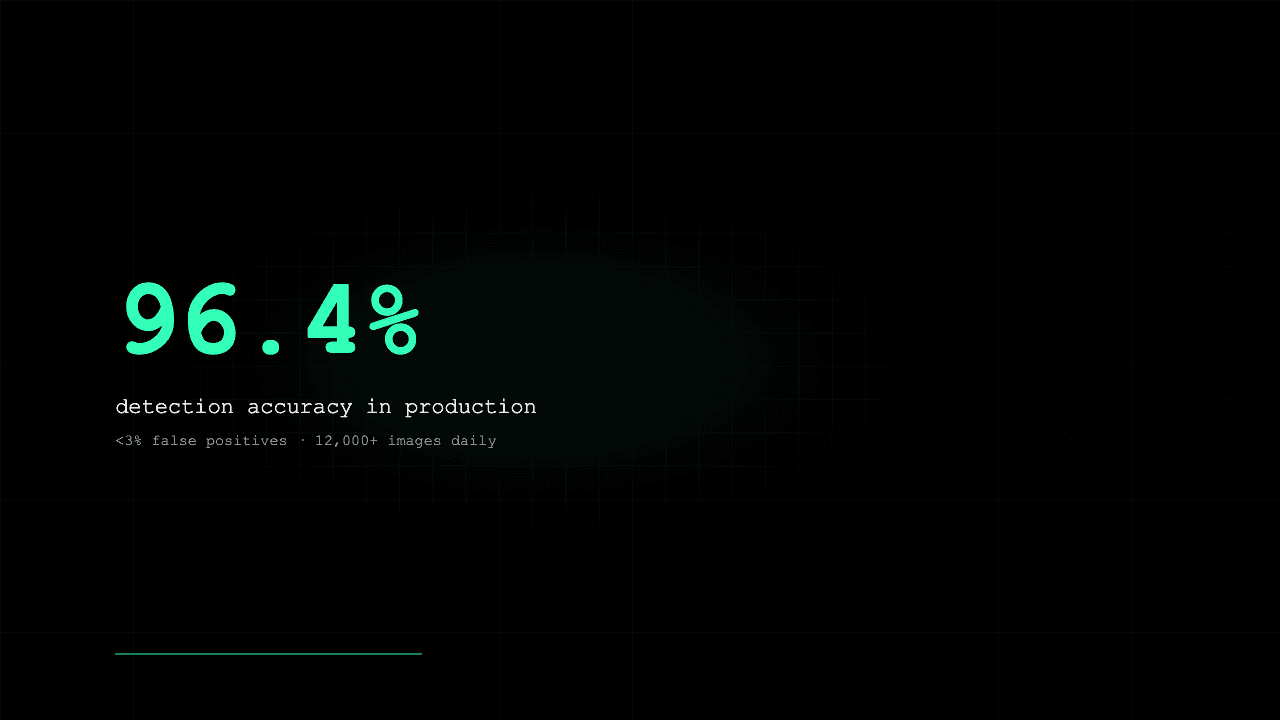
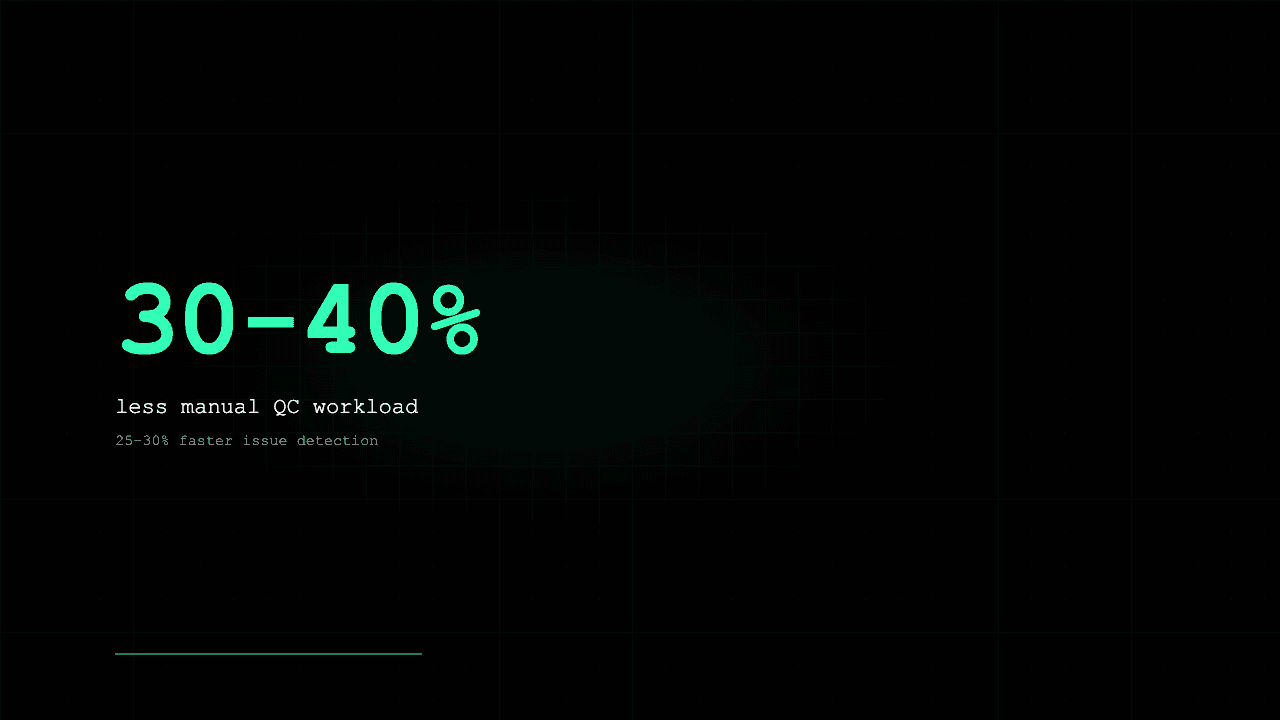
Philips Consumer Lifestyle BV applied few-shot learning to manufacturing quality control. Instead of collecting thousands of annotated examples, models train on 1-5 samples per defect type. They enhance accuracy by combining few labeled images with anomaly maps from unlabeled data — a hybrid approach that strengthens defect detection.
Production impact: comparable accuracy to traditional supervised models with dramatically reduced dataset creation cost and time. Philips can adapt detection systems rapidly to new defect types without overhauling pipelines — critical for short production runs and rapid design changes.
The architectural pattern: few-shot for known defect categories + anomaly detection for novel patterns. The model handles the bulk of quality control; humans review only edge cases.
Education: JustSoftLab GenAI sales training platform
We built a GenAI-powered sales training platform that automates onboarding by transforming internal documents (presentation slides, PDFs, audio) into personalized lessons and quizzes.
The few-shot approach was critical. We provided the LLM with a small set of sample course designs for different employee profiles:
- Template 1: structured training for a novice sales representative preferring gamified learning
- Template 2: traditional format plan for an experienced hire
The model generalizes from these few examples, factoring in each new hire's experience, qualifications, and learning preferences to generate customized study plans.
Production impact: training cycle reduced from 3 weeks (with classic fine-tuning) to a few hours (with few-shot prompting). The platform also enabled the 92% reduction in onboarding time we documented elsewhere — from 6 months to 2 weeks.
Finance: document processing
Hitachi India deployed few-shot learning to train document processing models on 50+ different bank statement formats. The system processes 36,000+ bank statements per month at 99% accuracy.
Grid Finance similarly used few-shot learning to extract income data from diverse bank statement and payslip formats — consistent, accurate results across varying document layouts.
Production impact: rapid adaptation to new document formats without retraining. New format = new few-shot examples in the prompt = ready in hours, not weeks. Critical advantage in finance where document formats vary by institution and update frequently.
Five executive concerns and mitigation strategies
1. Data quality as a strategic priority
Few-shot learning reduces volume requirements but increases the importance of selecting high-quality, representative examples. A small set of poor inputs produces weak results. Shift data strategy from "collect everything" to "curate the critical few."
Mitigation: invest in disciplined data governance, rigorous quality control, and careful selection of the samples that will define model behavior.
2. Ethical AI and bias mitigation
Few-shot learning carries forward biases embedded in pre-trained foundation models. Add to that biases in your few-shot examples, and the failure modes compound.
Mitigation: treat responsible AI governance as a priority — bias testing across protected classes, diversifying example sets where possible, transparency in decision logic, ongoing fairness monitoring in production.
3. Optimizing the "few" examples
The success of few-shot learning hinges on picking the right examples. Too few → underfitting. Poorly chosen → overfitting or systematic bias.
Mitigation: treat example selection as a strategic step. Use domain experts to curate representative samples. Validate through controlled experiments. Pair human insight with automated data analysis to identify examples that capture task diversity.
4. Sensitivity to prompt quality (LLM few-shot)
In LLM-based few-shot learning, the prompt determines the outcome. Well-crafted prompts produce relevant, accurate responses. Poorly designed ones produce inconsistency or errors.
Mitigation: treat prompt creation as critical engineering work. Involve domain experts. Test prompts iteratively. Maintain prompt versioning and regression testing as production discipline.
5. Managing computational demands
Few-shot learning reduces data preparation costs but still relies on large pre-trained models that can be computationally intensive at scale. Long prompts (with all the few-shot examples) cost more per query than short prompts.
Mitigation: plan infrastructure for the actual production traffic shape. Monitor unit economics monthly. At high volume, evaluate fine-tuning vs few-shot trade-offs. Explore parameter-efficient techniques (LoRA, prompt tuning) when fine-tuning becomes economically attractive.
Few-shot learning: practical recommendations
Five concrete steps for capturing few-shot learning value:
-
Identify high-volume tasks with limited training data. These are the highest-leverage targets for few-shot learning. Document classification, sentiment analysis, structured extraction, content moderation are all common starting points.
-
Curate 5-10 high-quality examples per task. Quality matters more than quantity. Domain experts should review and approve example selection.
-
Test prompt variations against eval sets. Build evaluation harnesses with golden examples. Measure accuracy, hallucination rate, refusal rate across prompt variants. Pick the version that hits gates.
-
Deploy with monitoring infrastructure. Track prompt performance in production. Watch for drift as input distributions evolve. Update examples and prompts as patterns shift.
-
Plan migration path to fine-tuning for high-volume workloads. When traffic justifies fine-tuning economics (typically 1M+ queries/month at similar quality), have a plan. Few-shot validates the workload; fine-tuning optimizes the unit economics.
FAQs
How is few-shot learning different from zero-shot learning? Few-shot uses a handful of labeled examples to guide model behavior. Zero-shot relies entirely on prior knowledge with just a task description. Few-shot typically delivers higher accuracy when even small amounts of relevant data are available; zero-shot is useful when no examples exist or rapid prototyping is needed.
How does few-shot learning improve LLMs? Through few-shot prompting: embedding 2-50 input-output examples in the prompt guides the model's reasoning, format, and tone for the task. Improves consistency, reduces ambiguity, aligns outputs with business requirements without retraining or fine-tuning.
Can few-shot learning replace fine-tuning? Often yes, especially for moderate-volume workloads. The crossover point where fine-tuning wins on economics is typically 1M+ queries/month. Below that, few-shot is usually faster, cheaper, and more flexible. Above that, fine-tuning's lower per-query cost dominates.
What's the practical limit on few-shot example count? Bounded by the model's context window. Modern long-context models (Claude with 200K+ tokens, GPT-4o with 128K tokens) handle 100+ examples easily. The practical sweet spot is usually 5-15 examples — enough to demonstrate the pattern, not so many that prompt cost dominates.
Should I use few-shot learning or RAG? Different tools for different problems. RAG retrieves relevant grounding context for each query. Few-shot demonstrates task patterns. Most production deployments use both — RAG for current factual knowledge + few-shot for task-specific reasoning. See RAG for reliable AI for deeper treatment.
Ready to evaluate few-shot learning for your AI deployment? Run the Project Estimator for a deterministic ballpark, or book a 45-minute Discovery with our GenAI engineers — we'll review your data availability, validate the right adaptation strategy (few-shot, fine-tuning, RAG, or hybrid), and tell you honestly which approach fits your workload.
Talk to the team behind this
Building something like this in production?
Our senior engineers ship this kind of work for real teams. 45-minute call, no pitch deck — just architecture, trade-offs, and whether we're the right fit for your problem.