
Understanding multimodal AI systems and the value they bring
Multimodal AI isn't a more capable LLM — it's a different production architecture with different trade-offs. Where it wins, where it loses, and what shipping it actually looks like.

Multimodal AI is not "a more capable LLM." It's a different production architecture, with different cost economics, different evaluation challenges, and a different set of failure modes. Treating it as a feature upgrade — "we'll just turn on multimodal" — is the most reliable way to overspend on a system that doesn't deliver more value than the unimodal baseline.
The honest framing: multimodal AI wins where multiple input streams genuinely contain decision-relevant information that no single modality captures. It loses (in cost-per-decision terms) when one modality is doing 90% of the work and the others are noise.
Gartner projects 40% of GenAI solutions will be multimodal by 2027. That's the headline. The engineering reality is that the projects that succeed are the ones that pick the right workload — manufacturing quality control, autonomous driving, medical imaging, content workflows — and design for the specific multimodal trade-off.
This article maps how multimodal AI actually works in production, what wins it pays off, and the failure modes we see across real engagements.
What multimodal AI is, in production terms
A multimodal AI system processes and combines inputs from multiple data types — text, images, audio, video, structured records — through a unified reasoning layer that produces a single output. The key word is "unified." Two separate models that each process different modalities and ensemble at the end is not multimodal AI; it's a multi-model system. Multimodal architectures fuse modalities into a shared representation that the model reasons over.
Concrete contrast:
| Aspect | Unimodal AI | Multimodal AI |
|---|---|---|
| Inputs | One data type (e.g., text or image) | Multiple types fused (text, image, audio, video, sensors) |
| Understanding | Narrow, context-limited | Holistic, cross-modal context |
| Example | Chatbot answering typed queries | Support system fusing text, screenshots, voice transcripts |
| Output quality | Generic, often misses nuance | Specific, cross-modal context |
| Best fit | Simple repetitive workflows | Complex high-stakes decisions where modalities encode complementary info |
The architectural difference is meaningful in production. Unimodal systems are easy to instrument, evaluate with standard metrics, and bound in cost. Multimodal systems require modality-specific encoders, fusion layers that align different data shapes into a shared embedding space, and evaluation harnesses that test cross-modal reasoning — not just per-modality accuracy.
How a multimodal pipeline actually runs
The five-stage architecture we deploy on multimodal projects:
1. Data preparation and encoding. Raw inputs (images, video, audio, text, structured data) get cleaned, standardized, and routed to dedicated encoders. Noise floor matters — a blurry image or noisy audio degrades downstream accuracy more in multimodal systems than unimodal because errors compound across modalities.
2. Feature extraction. Each encoder (vision transformer for images, speech model for audio, language model for text) extracts modality-specific features. The goal is to identify the decision-relevant signal in each stream and discard noise. Skipping or under-tuning this step is the single most common cause of multimodal underperformance — bad features in, bad fusion out.
3. Fusion. The extracted features get combined into a shared representation. Architecturally there are several options — early fusion (combine raw features), late fusion (combine post-encoder features), and cross-attention (let modalities attend to each other during fusion). The choice depends on how tightly coupled the modalities are. For autonomous driving where camera and LiDAR observations are tightly coupled in space and time, cross-attention dominates. For document Q&A with mostly text and occasional images, late fusion is often enough.
4. Contextual reasoning. The fused representation gets interpreted in context. The system weighs how modalities interact — a neutral text complaint paired with a photo of a cracked component plus stressed audio may flag as urgent; the same photo with calm audio may flag as routine. This is where multimodal earns its keep, or doesn't.
5. Output and action. The reasoning layer produces the system output — an alert, recommendation, classification, or generation. For agentic deployments, the output may trigger downstream actions through integration adapters.
Where multimodal AI wins in production
Five application areas where the multimodal trade-off pays off in real engagements.
Content creation and brand workflows. Multimodal systems combine text, images, audio, and video in single workflows — marketing teams provide briefs and brand assets, the system generates campaign materials across formats with consistency. Adobe Firefly is the reference example: integrated into enterprise content workflows, trained on company brand style, generates on-brand materials at scale. Forrester reports up to 577% ROI and ~70% productivity gains for businesses deploying it. The pattern: the modalities (text → image, image → video, image edit via natural language) genuinely interact, and the workflow lift comes from fusing them.
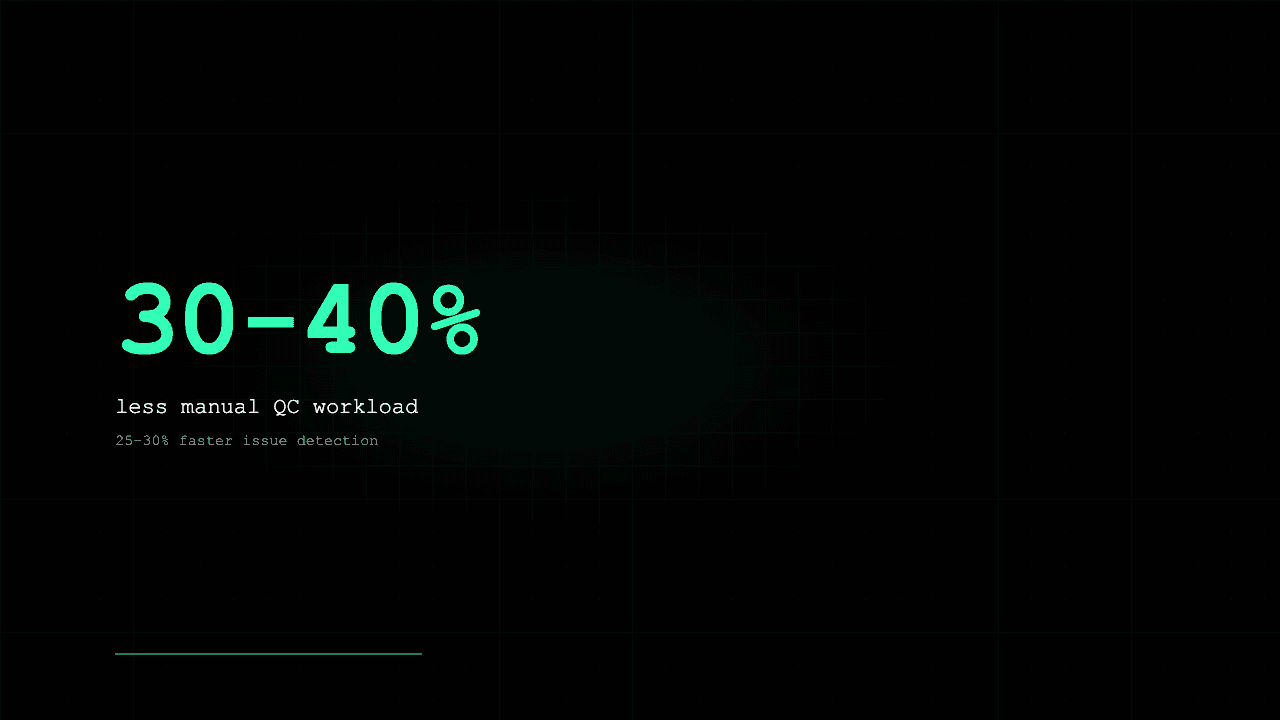
Manufacturing quality control. Factories combine high-resolution machine vision (defect detection, alignment), vibration and pressure sensors (machine health), microphones (audio anomaly detection), thermal imaging (heat signatures), and historical maintenance logs into integrated quality systems. Volkswagen Group runs multimodal AI across factories for vehicle quality and operational efficiency — analyzing images during component placement, fusing sensor data to flag early machine failure, and reports saving double-digit millions annually. The pattern: failure modes manifest in multiple modalities, and multimodal fusion catches what any single sensor would miss.
Research and R&D acceleration. Multimodal systems integrate scientific publications, lab experiments, imaging results, and structured datasets into coherent analysis. In drug discovery, this is particularly valuable — Montai Therapeutics partnered with NVIDIA BioNeMo to accelerate small molecule drug discovery, integrating chemical structures, phenotypic cell data, gene expressions, and biological pathway information to predict molecular function. Early results outperform single-modality approaches. The pattern: scientific reasoning requires correlating across heterogeneous evidence types, and multimodal fusion does that efficiently.
Autonomous driving. Cameras, radar, LiDAR, contextual maps, and traffic-rule knowledge get fused for trajectory prediction and decision-making in complex scenarios. Waymo's end-to-end multimodal model EMMA combines all these sensor modalities with textual world knowledge from Google Gemini to generate driving outputs. The pattern: safety-critical decisions in a physical environment require redundant sensing, and multimodal fusion both increases accuracy and adds graceful degradation when one sensor fails.
Medical imaging and diagnosis. Combining medical imaging, lab results, patient records, and clinical notes provides physicians a holistic view that no single data source delivers. A Chinese research team developed a multimodal system for early Alzheimer's diagnosis combining structural MRI (brain atrophy) with PET scans (metabolic impairment), achieving 98% accuracy on classification — outperforming unimodal baselines. The pattern: medical conditions manifest across modalities, and multimodal evidence is closer to how clinicians actually reason.
In each case, the multimodal architecture is justified by the workload — the modalities encode complementary information that no single modality captures. Where that justification doesn't hold, multimodal becomes overengineering.
Where multimodal AI goes wrong
Four production failure modes we see repeatedly:
Data integration complexity. Combining sequential text, pixel-based images, time-based audio, and frame-by-frame video means building robust preprocessing pipelines that clean, align, and synchronize inputs. Features from different modalities have to map into a shared embedding space. Without careful preprocessing — synchronization timestamps, normalization, alignment — the fusion layer gets garbage and produces garbage.
Compute cost. Multimodal models are expensive to train and run. A 7B-parameter multimodal model takes ~14GB of GPU memory just for weights, before activations and KV cache. Production inference often requires specialized hardware or aggressive optimization (knowledge distillation, quantization, pruning) to meet latency budgets. Plan for it.
Cross-modal hallucination. Multimodal systems can produce confident outputs from conflicting inputs. Standard unimodal evaluation metrics (perplexity, BLEU, accuracy) miss this — you need cross-modal evaluation harnesses that test specifically how the system reconciles contradictory or incomplete signals.
Bias amplification. Bias in one modality propagates and compounds across others. Language models trained on internet text inherit cultural stereotypes. Image datasets overrepresent certain demographics. Audio datasets favor certain accents and dialects. Fused multimodal systems don't just sum these biases — they amplify them. Without rigorous data governance and adversarial testing, this can render the system unfit for sensitive use cases.
For deeper treatment of how these patterns play out in regulated workloads, see our 10 RAG architecture mistakes — many of the same patterns apply when retrieval and generation operate across multiple modalities.
Production patterns we ship
Six engineering practices that consistently move multimodal projects from concept to production:
Optimize before scaling. Knowledge distillation (training smaller models from larger ones) and quantization (reducing precision to run on cheaper hardware) routinely cut compute cost 4–8× without meaningful accuracy loss. Apply these as defaults, not optimizations of last resort.
Right-size infrastructure. Spot Instances for flexible batch jobs save up to 90% on cloud GPU spend; serverless for lightweight tasks; Reserved Instances or Committed Use Discounts for predictable workloads. The mix of these on a single deployment can cut infrastructure spend up to 75% without performance impact.
Be ruthless about input filtering. Multimodal models pay for every token, every pixel, every audio sample they process. Filter and preprocess upstream so models see only decision-relevant data. Limit response formats. Batch prompts. The unit economics live or die on this.
Modular architecture. Build the system as composable pipelines, APIs, and microservices that can be reconfigured as models evolve. This avoids vendor lock-in, reduces rework, and lets you swap modality encoders or fusion strategies as better options ship. The 18-month half-life of frontier multimodal models makes modularity essential, not optional.
PoC before commitment. Multimodal projects have higher uncertainty than unimodal at the same scope. Start with a 4–6 week proof of concept that validates the multimodal architecture genuinely outperforms a unimodal baseline on the actual workload. If it doesn't, fall back to the simpler architecture. We see this PoC step save more budget than any other single practice.
Automate monitoring and retraining. Drift in multimodal systems is harder to detect than unimodal — the failure modes are subtle (modality balance shifts, fusion weights drift) and don't show up in standard unimodal metrics. Build modality-specific drift detection, retrigger retraining on threshold breach, and budget 15–20% of initial cost annually for these activities.
FAQs
How is multimodal AI different from a regular text-only AI model? Traditional AI processes one type of data; multimodal AI processes multiple types in a single unified reasoning layer. The architectural difference matters: multimodal systems require modality-specific encoders, fusion layers, and cross-modal evaluation. They also bring different cost economics — typically 2–4× the compute of unimodal at the same task — and only justify that premium when the workload genuinely contains complementary signal across modalities.
How does a multimodal agent process image, text, and audio together? Each input goes through a specialized encoder (vision transformer for images, speech model for audio, language model for text). The encoded features are fused in a central layer that aligns different data streams into a shared representation. The reasoning model interprets this fused representation and generates output. The fusion strategy (early, late, or cross-attention) is the key architectural choice — and it depends on how tightly coupled the modalities are in your workload.
What does multimodal generative AI do that traditional GenAI doesn't? Traditional GenAI generates content in one format (text from text prompts). Multimodal GenAI generates across formats — image or video from text, captions from images, speech synthesis from text and visuals. For enterprise applications, this opens workflows that require format transformation: marketing campaigns across channels, accessibility content (captions, transcripts), product visualization from descriptions.
What ethical and privacy risks come with multimodal AI? Three primary risks. Bias propagation — bias in one modality amplifies across others. Sensitive data misuse — images, voice recordings, video footage may contain PII that requires explicit handling. Cross-modal hallucination — systems producing confident outputs from conflicting inputs, harder to detect than unimodal hallucination. Strong data governance, modality-specific dataset audits, and transparent model monitoring are non-negotiable for production deployments handling regulated data.
What are the trade-offs when deploying multimodal AI? Higher compute cost (2–4× unimodal at the same task), more complex infrastructure (modality-specific encoders, fusion layers), harder evaluation (cross-modal metrics, not just per-modality accuracy), and longer time-to-production (PoC + integration cycles). The trade-off is justified when the workload genuinely contains decision-relevant information distributed across modalities. When it doesn't, you're paying for capability that doesn't materialize.
Ready to scope a multimodal AI project? Run the Project Estimator for a deterministic ballpark, or book a 45-minute Discovery with our GenAI engineers — we'll help you decide whether multimodal is the right architecture for your workload, or whether a simpler unimodal system delivers the same outcome at lower cost.
Talk to the team behind this
Building something like this in production?
Our senior engineers ship this kind of work for real teams. 45-minute call, no pitch deck — just architecture, trade-offs, and whether we're the right fit for your problem.