
Small language models (SLMs): a smarter way to get started with generative AI
Small language models aren't a lite version of LLMs — they're a different production trade-off. Where they win, where they lose, and how we ship them on regulated workloads.
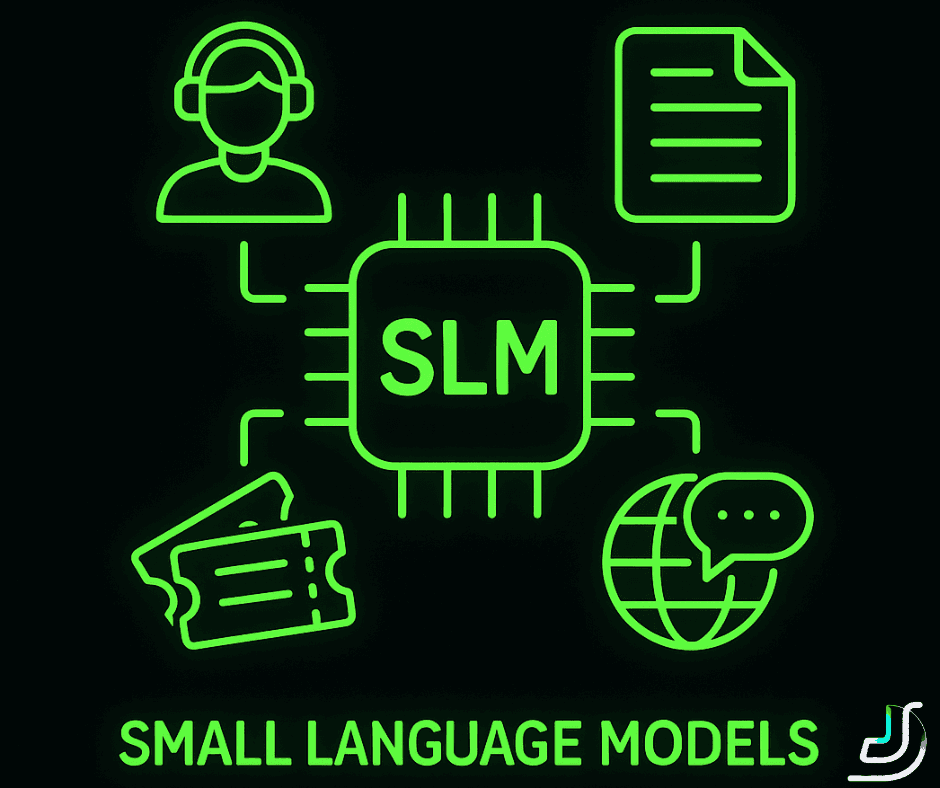
Small language models aren't a "lite" version of LLMs. They're a different production trade-off. Most teams treat the SLM/LLM choice as "small for cheap, large for capable" — that framing leads to wrong decisions in both directions. The honest decision criteria are about latency budget, data residency, task domain width, and 1M+ query unit economics — not about how much capability you want.
This article is the version of the SLM conversation we have with engineering leaders before scoping a GenAI project — what SLMs are in 2026 terms, where they win in production, where they don't, and how we adopt them at JSL.
What an SLM actually is in 2026
The "small" in SLM is a moving target. In 2023, anything under 10B parameters was small. By 2026, the production-ready open-source SLM landscape has consolidated around a handful of families that punch above their weight:
- Microsoft Phi-4 (~14B) and Phi-3.5 (~4B) — strong reasoning per parameter, designed for on-device and edge deployment
- Mistral 7B / Ministral 3B / 8B — production-stable, strong fine-tuning ergonomics, good multilingual coverage
- Meta Llama 3.2 (1B / 3B / 8B) — broad community support, mature tooling, good base for domain fine-tuning
- Google Gemma 2 (2B / 9B) — Google-quality safety tuning out of the box
- Apple OpenELM (270M / 450M / 1.1B / 3B) — extremely small, designed for on-device
What makes a model genuinely "small" for production purposes isn't a parameter count threshold. It's whether the model can run on your existing infrastructure with predictable latency under your peak load — typically a single GPU or CPU pool, not a multi-node cluster, and inference under your latency budget. By that standard, anything in the 1B–13B range qualifies for most enterprise workloads in 2026.
When SLMs win in production
The decision criteria we use on real engagements aren't about "capability" — they're about specific production constraints.
Latency budget tight. Sub-300ms p99 inference is realistic on a small model fine-tuned for the task. The same workload on GPT-4 or Claude Opus is bounded by network round-trip plus several seconds of generation time. For real-time customer interactions, in-vehicle assistants, or trading desks, the gap is the difference between shipped and not shipped.
Data residency required. Healthcare under HIPAA, finance under SR 11-7 and DORA, EU AI Act high-risk deployments, government and defense workloads — all require data to stay in customer-controlled infrastructure. Hosted LLM APIs are a non-starter. SLMs run on-prem or in a private VPC, with audit-grade logging joined to user identity. We treat this exact pattern as the default in our fintech RAG reference architecture.
Narrow task domain. When the agent only handles support ticket triage, contract clause extraction, sentiment scoring, document classification, or a similarly bounded workflow, a fine-tuned SLM regularly outperforms GPT-4 on accuracy. The fine-tuning compresses domain knowledge into the weights instead of paying for it on every query through long prompts and retrieval.
1M+ queries per month. This is where SLM unit economics dominate. Foundation-model APIs price per token; SLMs running on infrastructure you already own price per GPU-hour, fixed. The crossover point depends on your traffic shape, but for any high-volume support, document processing, or analytics workload at enterprise scale, the LLM bill becomes the largest line item by month three of production.
Energy and sustainability constraints. SLMs draw roughly 90% less power per inference than frontier LLMs. For ESG-reporting enterprises, large-scale automation projects, and edge deployments running on battery, this matters in both compliance and operational cost.
When SLMs lose
Equally important — when not to choose an SLM:
- Open-domain reasoning. If the workload requires the model to handle arbitrary user questions across multiple domains, multi-step reasoning, or novel scenarios it wasn't fine-tuned for, larger frontier models still dominate.
- Multimodal generation. Image, video, and audio generation are still LLM-class workloads. SLMs handle multimodal input passably, but generating new content benefits from the parameter count.
- Few-shot variability. When you need the model to adapt to vague instructions or single-example task definitions, larger models pick up the pattern more reliably.
- Limited eval data. SLMs need a golden set to fine-tune against. If you can't assemble 500–2000 high-quality task examples, the SLM will under-fit and you're better starting with an LLM and an evaluation harness, then distilling later.
The production trade-off table
| Dimension | Small language model (1B–13B) | Frontier LLM |
|---|---|---|
| Parameters | 1B–13B | 70B–500B+ |
| Training time (custom) | Hours to days | Months |
| Inference latency | 50–300ms typical | 800ms–5s typical |
| Per-query cost at scale | Fixed (GPU-hour) | Variable (per-token) |
| Hosting | On-prem, private cloud, edge | Hosted API or large GPU cluster |
| Data residency | Full customer control | Hosted provider |
| Customization | Fine-tuning + adapters | Mostly prompt + retrieval |
| Hallucination on narrow tasks | Lower (tighter training scope) | Higher (broader prior) |
| Open-domain capability | Limited | Strong |
The right answer is rarely binary. The pattern we see most often in production is hybrid: an SLM handles 80–95% of the routine traffic, with an LLM available as a fallback for the edge cases the SLM declines to answer with confidence. Routing logic decides which model gets the query, and the system tracks the split for cost and quality reporting.
What real production deployments look like
Several public examples worth knowing — these aren't JSL engagements, but they're the cleanest publicly available references for the patterns we deploy.
Rockwell Automation deployed Microsoft Phi-3 for industrial machine operators. Technicians query the model in natural language to troubleshoot equipment and access procedural knowledge, all without leaving the workstation. The pattern: domain-specific fine-tuning + on-device deployment for low-latency, low-connectivity factory environments.
Cerence introduced CaLLM Edge, an SLM embedded in automotive software. Drivers access voice assistance, search, and navigation without cloud connectivity. The pattern: SLM as the primary, with optional cloud fallback when connectivity exists — exactly the hybrid routing model.
Bayer built E.L.Y., an agronomic SLM that answers difficult agronomic questions and supports real-time decision-making. Reported outcomes: ~4 hours saved per week per user, 40% improvement in decision accuracy. The pattern: domain knowledge baked into the weights, deployed close to the user, integrated with existing data infrastructure.
Epic Systems adopted Phi-3 in its patient support system. The model runs on-premises, keeping protected health information inside the hospital network and complying with HIPAA. The pattern: data residency as the primary constraint, SLM as the only viable architecture.
In each case, the SLM choice wasn't "we wanted to save money" — it was a specific production constraint (latency, residency, edge deployment) that ruled out hosted LLMs.
How we adopt SLMs at JustSoftLab
The four-step playbook we run on real engagements:
1. Scope the workload, not the model. Before evaluating any model, we pin down the task definition, latency budget, throughput, regulatory constraints, and what acceptable accuracy looks like. Most "we want an SLM" requests at intake actually require a different decision — sometimes the workload doesn't need a generative model at all (a fine-tuned classifier is cheaper and more reliable), sometimes it actually needs a frontier LLM. The honest scope conversation is the most valuable hour of the engagement.
2. Build the eval set first. Before any fine-tuning, we assemble 500–2000 representative input/output pairs that define what success looks like. Hallucination rate, refusal rate, citation accuracy, latency p99, and cost-per-query become deployment gates — not afterthoughts. If we can't get a clean eval set together, the project isn't ready, regardless of how nice the candidate model is.
3. Run a candidate bake-off. We typically benchmark 2–3 SLM candidates (a Phi family member, a Mistral or Llama variant, sometimes a Gemma) against the eval set, with and without fine-tuning. The bake-off also includes an LLM baseline so we know what we're trading away. Results go into a candidate-selection memo that's joinable to architecture choices downstream.
4. Ship with monitoring, retrain on schedule. Production SLM deployments need observability tied to retrieval and generation components, golden-set re-evaluation on every prompt or model change, and a cadence for retraining as data and behavior shift. Budget 15–20% of the initial build cost annually for these activities — it's not optional, it's the cost of running a learning system.
Where SLM projects most often fail
Three failure modes we see repeatedly:
Under-curated training data. Teams fine-tune on whatever they have, instead of constructing a clean, diverse, balanced training set. The model overfits to the noise. Fix is upstream: spend the data prep budget on representative coverage of the task surface.
No evaluation harness. Teams ship the model on vibes. Three months in, they realize hallucination rate is 4× what they assumed, and there's no system in place to detect drift. Fix is to build the eval before any fine-tuning, and gate every model and prompt change on it.
Over-distillation. Teams aggressively shrink the model to reduce inference cost, push past the size threshold where it can still handle the task, and end up with a model that's fast and broken. Fix is to benchmark on real load, not toy queries, and pick the size where the eval-set numbers actually hold.
For deeper treatment of how these patterns play out specifically on RAG workloads — which often pair with SLMs for fintech and healthcare — see our 10 RAG architecture mistakes article.
FAQs
How do small language models differ from large language models? SLMs are optimized for specific tasks, run on existing infrastructure, and fine-tune economically. LLMs handle open-domain workloads, scale to broader use cases, and dominate when the task surface is wide. The trade-off isn't "small for cheap, large for capable" — it's about latency budget, data residency, and unit economics at scale. For narrow high-volume workloads with strict residency, SLMs win. For variable open-domain workloads, LLMs do.
What are the main use cases for small language models? Customer support automation (FAQ handling, ticket routing), internal knowledge assistance (HR and IT queries against company documentation), regulatory document review (contract clause extraction, compliance reporting), multilingual support in offline or low-connectivity environments (manufacturing, remote ops), HIPAA-compliant patient data processing, and edge deployments where cloud connectivity is unavailable.
Can I use SLMs and LLMs together? Yes — and most production deployments do. The pattern: an SLM handles the 80–95% of traffic that fits its trained domain, with an LLM as fallback for edge cases the SLM declines or scores low confidence on. Routing logic decides per query, and the system tracks the split for cost and quality reporting. This converts unpredictable per-token spend into a mostly-fixed infrastructure cost, with a manageable variable LLM bill on the long tail.
How long does an SLM project take to ship? For a focused production SLM with a defined task, expect 6–12 weeks from scoping to deployment, assuming clean training data and a well-defined eval set. Add 4–8 weeks if the data prep needs significant work, or if compliance review (HIPAA, SOC 2, GDPR) is on the critical path.
Ready to scope an SLM project? Run the Project Estimator for a deterministic ballpark, or book a 45-minute Discovery with our AI engineers — we'll help you decide whether an SLM, an LLM, or a hybrid is the right fit for your workload.
Talk to the team behind this
Building something like this in production?
Our senior engineers ship this kind of work for real teams. 45-minute call, no pitch deck — just architecture, trade-offs, and whether we're the right fit for your problem.