
Estimating healthcare app development costs: JustSoftLab experts weigh in
Honest engineering breakdown of healthcare app development cost in 2026 — five factors that drive the price, real cost ranges by app type, and five engagements with concrete numbers.
Healthcare app development cost ranges aren't tidy. The honest band: $100K–$200K for a focused custom mHealth MVP, scaling to $400K–$800K for full-featured platforms with multi-channel integration, advanced features, and full HIPAA compliance. The spread is real — it reflects whether you're building a focused tool for one workflow or a comprehensive patient-and-clinician platform.
The mHealth market is large enough to justify serious investment. Grand View Research valued it at $37.5B in 2024 with 14.9% CAGR through 2030. Top-tier consumer mHealth apps like Blood Sugar reach 2.93 million downloads annually. The opportunity is genuine — the question is what your app actually needs to do, and what compliance load comes with that scope.
Five factors explain almost every cost gap we see between healthcare app engagements. This article maps each, with real engagement cost ranges anchored to five JustSoftLab portfolio projects. For broader healthcare positioning, see our industry hub.
Five factors that drive healthcare app cost
A few notes before the breakdown. Cost estimates assume you have detailed requirements documentation. The discovery phase itself adds roughly $25K to any healthcare app project — and skipping it is the most common cost-overrun trigger we see. Estimates also focus on custom-built solutions; low-code/no-code options exist but trade customization for vendor lock-in and limited scalability, which rarely pencils out for serious healthcare workloads.
1. Target user base — patients vs medical professionals
Apps for clinicians (doctors, nurses, pharmacists) carry stricter compliance load — HIPAA-bound from day one, encrypted at rest and in transit, audit-logged for clinical decisions. Common workflows include clinical decision support, patient consultation and remote monitoring, EHR integration, prescription management, and billing.
Apps for patients support healthier lifestyles and better outcomes — appointment scheduling, condition monitoring, symptom checking, mental health support, medication reminders. Compliance is still serious (HIPAA when handling PHI; FTC and state laws for consumer health data) but the architectural surface is often narrower.
The trade-off in cost terms: clinician apps tend to require deeper EHR/EMR integration (where most of the cost lives), patient apps tend to require richer UX and broader device compatibility.
2. App type
Cost ranges by category, assuming a single platform and basic functionality:
E-prescription apps. Doctors prescribe, monitor, cancel, renew. Functionality varies by jurisdiction — some markets allow direct pharmacy integration, others require pickup workflows. Reference example: ScriptSure. Cost: from $120K for one platform plus back end.
Telehealth platforms. Online consultations, EHR linking, video conferencing, file transfer, e-prescription, billing, patient monitoring. Comprehensive HIPAA-compliant platforms like Amwell serve thousands of medical facilities. Cost: from $200K for a custom telehealth solution.
Remote patient monitoring. Sensor-based data collection outside medical facilities, with clinician dashboards and alerting. MedM integrates 600+ medical sensors and consolidates with Google Fit and Apple Health. Cost: from $250K for two front ends (patient + clinician) connecting to consumer electronics. Custom monitoring devices add bespoke pricing per device.
Symptom checker apps. Symptom-based illness identification with referral suggestions. Ada covers 1,500+ diseases with clinical-grade accuracy. Cost: from $100K, with the main complexity being the digitization of medical decision logic.
Clinical diagnostic platforms. For healthcare professionals — gathering and analyzing patient data from IoT sensors, cameras, EHRs, with collaborative case discussion. Human Dx is a community-driven example. AI-powered diagnostic recommendations push the complexity higher. Cost: from $200K for a basic diagnostic platform.
3. Features
Healthcare app features split into baseline and advanced. Baseline features are table stakes for any production deployment; advanced features differentiate the product.
Baseline features ($30K–$60K total, varying by depth):
- User registration and onboarding with PHI-safe data capture
- Patient profile management
- Appointment scheduling and calendar integration
- Secure messaging (HIPAA-compliant)
- Notifications and reminders
- Payment integration
- Basic dashboard for users and clinicians
- Audit logging
Advanced features ($60K–$200K+ depending on scope):
- EHR/EMR integration (Epic, Cerner, Athena) — $25K+ per system
- Telemedicine video conferencing with PHI-grade security — $40K+
- Wearable and IoT device integration — $15K+ per device class
- AI-powered features (diagnosis assistance, content recommendations, risk scoring) — see below
- AR-based features (medical training, surgical guidance) — $50K+
- E-prescription with pharmacy integration — $30K+
- DNA analysis and genomic processing — $50K+
- Multi-channel patient communication (SMS, email, WhatsApp) — $20K+
- Family account management with PHI sharing controls — $25K+
- Insurance claims processing — $40K+
The cost compounds non-linearly. A telehealth app with EHR integration, AI-powered triage, and wearable integration is materially more expensive than the sum of those features built in isolation, because integration testing, compliance review, and observability scale with feature count.
4. Innovative technologies
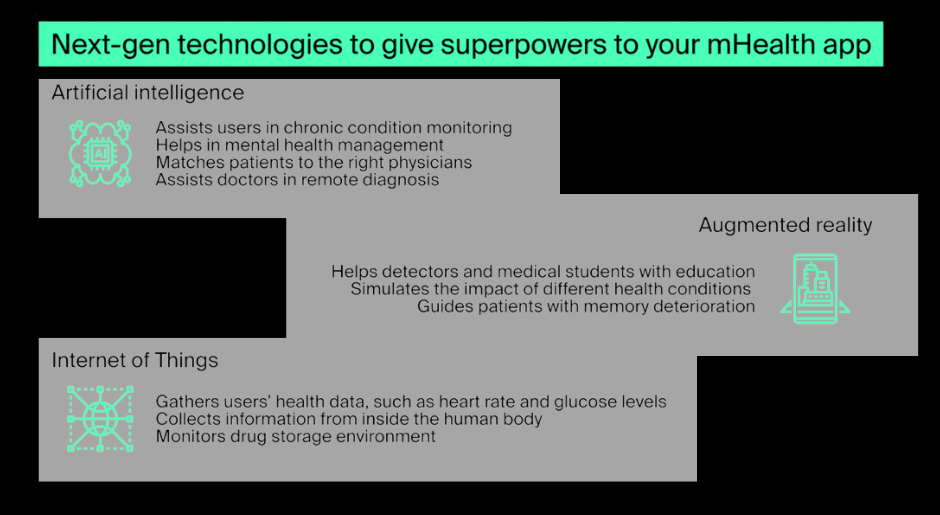
Artificial Intelligence. AI in mHealth ranges from simple recommendation engines to complex diagnostic models. Cost depends on AI maturity:
- Off-the-shelf AI (face recognition, sentiment analysis, basic NLP): integration cost $10K–$30K
- Customized AI models (fine-tuning foundation models, classical ML on your data): $50K+
- Built-from-scratch deep learning for clinical use: $80K–$300K+
For deeper treatment of healthcare AI cost specifically, see our healthcare AI cost article. For broader AI cost framing, see calculating the cost of generative AI and how much does AI cost in 2026.
Augmented Reality (AR). Used for medical training, surgical guidance, anatomy visualization, and patient education. AR development requires specialized expertise (Unity, Unreal, ARKit, ARCore) and 3D content creation. Cost: $50K–$200K+ depending on content depth and accuracy requirements.
Internet of Things (IoT). Sensor data ingestion from medical devices, wearables, and smart home equipment. Each device class brings its own integration cost — proprietary protocols, certification requirements, real-time data pipelines. Cost: $15K–$100K+ depending on number of devices, communication protocols, and real-time data processing needs.
5. Compliance and certification
Compliance overhead in healthcare is substantial — it's the line item teams underestimate most.
HIPAA (US). Authentication, encryption at rest and in transit, audit logging, breach notification, RBAC. HIPAA certification alone runs $10K–$150K depending on organization size. Engineering work to actually meet requirements is typically 2× the certification cost.
HITECH (US). Builds on HIPAA with stricter breach notification and patient access requirements. Adds 10–20% to the HIPAA implementation work.
GDPR (EU). Stricter consent management, right to be forgotten, data portability. Adds $20K–$50K of engineering work for EU-deployable apps.
FDA pathway. If the app is classified as Software as a Medical Device (SaMD) — for example, a diagnostic decision-support system — FDA 510(k) clearance or De Novo pathway adds 12–24 months and $200K–$1M+ in regulatory work. Most early-stage healthcare apps deliberately scope below the SaMD threshold (information-only, not diagnostic) to avoid this overhead.
Other. State-specific privacy laws (California CCPA, NY SHIELD), industry standards (HITRUST, SOC 2 Type II for vendor relationships), accessibility (WCAG 2.1 AA for any government or institutional deployment).
Compliance baseline starts at $20K for a single-jurisdiction deployment with HIPAA. Full multi-jurisdiction compliance for enterprise healthcare deployments routinely lands at $80K–$200K just for the regulatory work, before any product engineering.
The discipline that separates successful healthcare app projects: scope compliance early, build it into the architecture from day one, and don't promise capabilities (like SaMD-class diagnostics) without budgeting the regulatory pathway.
Real engagements from the JustSoftLab portfolio
Five healthcare app projects we've shipped, with cost ranges that anchor the abstract numbers above.
Custom heart rate monitor with iOS app
A digital health startup partnered with us to build a heart rate monitoring device with an iOS app for real-time data visualization and emergency alerting. To handle real-time sensor aggregation, we used the OpenGL API and offloaded part of the workload to the mobile GPU.
Cost: from $100K. Duration: 3 months. Stack: iOS SDK, C, OpenGL ES.
CSV-to-HL7 converter web app
A Chicago-based software company partnered with us to build a web app that standardizes medical data by converting CSV-formatted entries into HL7-compliant messages. Three modules: CSV parser, HL7 converter, FTP uploader for downstream system delivery.
Cost: from $100K. Duration: 3 months. Stack: C#, .NET Core, ASP.NET Core, Entity Framework Core, xUnit, Bootstrap, SQL.
Habit-formation companion app for clinics
A digital health startup commissioned a mobile app for clinics to support patients in adopting healthier habits. The app tracks long- and short-term goals, delivers coach feedback, manages meal and workout plans, books doctor appointments, and integrates with the clinic's management system to surface lab results.
Cost: $400K–$600K. Duration: 8–10 months. Stack: React, React Native, AWS, Node.js.
Heart-failure post-discharge support app
A multinational biotech company partnered with us to build a device-agnostic mobile-first web app supporting heart failure patients during their first 100 days post-discharge. Patients create profiles, link caregiver accounts, and receive personalized content via SMS, email, or WhatsApp.
Cost: $400K–$600K. Duration: 9 months. Stack: React, Java 11, Spring, Spring Security, Adobe Experience Manager, MySQL, Google Analytics, AWS, Twilio.
Personalized health plan platform (HIPAA + GDPR)
A healthcare platform serving multiple jurisdictions. Patients register, complete an introductory survey, and receive personalized health plans with notifications and reminders. Includes chat and video calls with physicians, family account management with PHI sharing controls, AI-powered content recommendation, and a DNA analysis tool built on BioJava.
Cost: $600K–$800K. Duration: 5–6.5 months. Stack: React.js, Java, AWS, Kotlin, Swift.
The pattern across these five engagements: focused single-platform projects land at $100K–$250K. Multi-platform consumer apps with rich features cluster at $400K–$600K. Enterprise platforms with multi-jurisdictional compliance and AI/genomic features push toward $800K. Each is justifiable on its specific scope.
How to reduce healthcare app development cost
Eight practical tactics from our engagements:
Minimize integrated wearable devices. Each device adds development effort, certification, and licensing fees. Pick the smallest set that delivers your core value proposition. Adding more later is cheaper than building all of them at MVP.
Use a unified protocol across your hardware. If you control the hardware portfolio, standardize the communication protocol. Integration code written once and reused across devices saves substantial engineering effort.
Build on FHIR and HL7 for hospital integration. Standards-based integration with EHR/EMR systems is cheaper to maintain than custom adapters per institution.
Use open-source healthcare tools. OpenCDS is a standards-based clinical decision support framework with built-in protocols for hospital communication, a business rules engine, and a verified drug database. Saves significant integration work compared to building from scratch.
Don't add AI prematurely. Heuristic rules and hard-coded logic can deliver useful functionality at MVP cost. Add AI in later phases when you have data to validate accuracy gains. Skipping this discipline is the most common reason healthcare AI features ship over budget and underperform.
Scope compliance to actual jurisdictions. Don't try to comply with every global regulation upfront. Identify your launch jurisdictions and meet those standards rigorously. Expansion compliance work is cheaper when added incrementally to a sound foundation.
Tailor accessibility to actual user demographics. Senior or disability-focused apps need to meet WCAG 2.1 AA from day one. Apps for younger demographics don't need that overhead — but they may need different platform-specific UX considerations.
Choose platforms strategically. Cross-platform (React Native, Flutter) is cheaper for content-heavy apps. Native (iOS Swift, Android Kotlin) is necessary when deep hardware integration or performance matter. Mixed strategies — native for the parts that need it, cross-platform for the rest — are increasingly common.
The MVP discipline above all: focus on the core features that satisfy initial user demand, ship to real users, learn what actually moves engagement, and expand from there. Healthcare apps that try to ship the full feature roadmap on first release routinely overrun and underperform.
FAQs
How much does a healthcare app actually cost? The honest range: $100K–$200K for a focused single-platform mHealth MVP with HIPAA compliance baseline; $400K–$600K for full-featured cross-platform apps with EHR integration; $600K–$800K+ for enterprise platforms with multi-jurisdictional compliance and advanced features (AI, AR, genomics). The exact landing point depends on the five factors above.
What's the cheapest viable path to validate a healthcare app idea? PoC + MVP, sequenced. PoC at $25K–$40K validates the core hypothesis on real data. MVP at $100K–$200K ships to real users at limited scope. Skip the discovery phase and you'll pay 30–50% more in the long run.
How long does a healthcare app project take? Plan in calendar quarters. PoC: 4–8 weeks. MVP: 12–24 weeks. Production with full HIPAA compliance: 24–52 weeks. SaMD pathway (if applicable): 12–24 months. Compliance review cycles add 8–16 weeks per phase.
What's the biggest single source of cost overruns in healthcare apps? Integration with EHR/EMR systems. Hospitals run dozens of legacy systems with poor documentation; the integration work is consistently underestimated by 30–50%. Plan for it explicitly during scoping.
Should I build a custom app or use a low-code platform? For consumer-grade apps with light compliance, low-code can work — but it caps your customization and creates vendor dependency. For enterprise healthcare workloads with serious compliance requirements (HIPAA, FDA pathway, multi-jurisdictional), custom development almost always pencils out better long-term.
Have a healthcare app idea? Run the Project Estimator for a deterministic ballpark, or book a 45-minute Discovery with our healthcare engineering team — we'll review your scope, compliance constraints, and integration surface and tell you honestly what the right architecture and budget look like.
Talk to the team behind this
Building something like this in production?
Our senior engineers ship this kind of work for real teams. 45-minute call, no pitch deck — just architecture, trade-offs, and whether we're the right fit for your problem.