
How AI agents transform the healthcare sector
Where AI agents are genuinely shipping in healthcare today — six production use cases with real deployment data, the compliance discipline that separates pilots from production, and what's still too risky to deploy autonomously.
AI agents are shipping in healthcare today — but only the deployments with rigorous compliance discipline reach production. The hype around autonomous medical AI has gotten ahead of clinical reality. Real deployments handle defined workflows (documentation, monitoring, intake, drug discovery analysis) with explicit human-in-the-loop gates for any clinical decision. The agents that try to go end-to-end autonomous in regulated workflows still stall in pilot.
This article maps where agents are working in healthcare today, with public references to real deployments, and what the implementation discipline actually looks like. For broader AI agents framing, see what are AI agents. For healthcare AI cost economics, see assessing the cost of implementing AI in healthcare. For broader healthcare positioning, see /industries/healthcare.
The compounding crisis healthcare AI agents address
~250,000 lives are lost annually to preventable medical errors in the US alone. The system pressures driving these outcomes — staffing shortages, unsustainable costs, operational breakdowns, data volumes that outpace human capacity — are exactly the conditions where AI agents have the highest leverage. Unlike narrow ML models that flag anomalies in scans or predict billing codes, agents can take action, make context-aware decisions, and execute multi-step workflows with bounded autonomy.
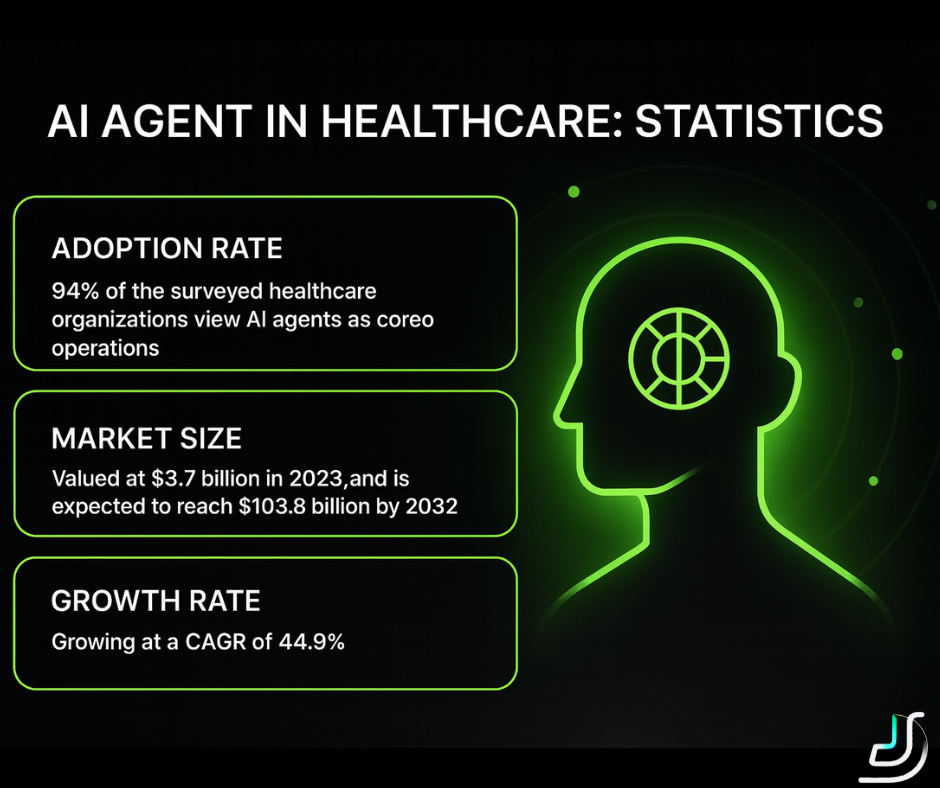
The market reflects the opportunity. Per Blue Prism's Global Enterprise AI Survey 2025, 94% of healthcare organizations now treat agentic AI as a core operational priority. The AI agents market was valued at $3.7B in 2023 and is projected to reach $103.6B by 2032 (44.9% CAGR). Healthcare is among the fastest-growing segments.
What separates AI agents from traditional automation
| Dimension | Traditional automation (RPA, rule-based) | AI agents |
|---|---|---|
| Core principle | Predefined rules; executes fixed tasks | Autonomy; makes decisions, adapts to context, pursues goals |
| Learning | Doesn't learn; manual reconfiguration on change | Learns via reinforcement, memory, fine-tuning |
| Cognitive ability | None — no reasoning, no understanding | Decision-making, problem-solving, unstructured-data reasoning |
| Implementation | Cheaper, faster for simple tasks | More resources, training, oversight |
| Best fit | Highly structured, repetitive, deterministic tasks | Complex, dynamic, unstructured workflows requiring judgment |
Agents differ from chatbots in a similar way: chatbots respond to prompts; agents break complex tasks into sub-steps, make decisions autonomously, and execute actions on behalf of the user. Chatbots wait for human prompting; agents take initiative within bounded scope. The distinction matters in healthcare because the cost of confidently-wrong autonomous action in clinical settings is high — agents need explicit governance gates that chatbots typically don't.
Where AI agents ship in healthcare today
Five core benefit categories driving real deployments:
- Revenue cycle management. Agents proactively spot coding errors, missing documentation, and potential fraud before claims go out — unlike traditional systems that only react after denials.
- 24/7 patient support. Virtual assistant agents handle questions, scheduling, medication reminders without delay, fatigue, or inconsistency.
- Patient management at scale without scaling staff. Sword Health, a digital health company, plans to expand physician caseload from 400 to 700 patients using AI for triage and communication. Cencora's voice agent Eva handles insurance-related calls equivalent to 100 full-time employees.
- Reduced physician burnout. Research shows AI assistants reduce physician documentation time by 70% — meaningful when documentation is the largest contributor to clinician burnout.
- Lower cost per patient. Agents drafting reports, scheduling appointments, communicating with patients, and following up after discharge cumulatively reduce per-patient cost without compromising care quality.
Six production use cases with public references
1. Diagnostic assistants
AI agents analyze diverse clinical data (imaging, labs, history, genomics) for faster, more comprehensive diagnoses. Unlike static-prediction tools, diagnostic agents adapt in real time — request missing information, revise assessments as new data arrives, integrate multiple data streams.
Reference deployment: Microsoft's AI Diagnostic Orchestrator (MAI-DxO) simulates a virtual panel of physicians by coordinating multiple AI models for clinical reasoning — asking follow-ups, verifying its own decisions. In benchmarks, MAI-DxO paired with OpenAI's o3 correctly diagnosed 85.5% of complex cases vs. ~20% for experienced physicians on the same benchmark.
The architectural pattern: multi-agent reasoning with internal verification, paired with explicit clinical handoff to human physicians for final diagnosis. The agent isn't replacing the clinician — it's expanding the analytical surface the clinician operates on.
2. Patient monitoring
Continuous oversight that interprets data rather than just collecting it. Detects early warning signs and escalates before issues become critical.
Reference deployment: LookDeep Health deployed an AI agent platform for in-hospital patient monitoring using computer vision. Real-time video feeds analyzed for patient behavior, movement patterns, room occupancy, motion tracking, safety breaches. Detects subtle patterns periodic clinician assessments miss.
The pattern: continuous CV-based monitoring + agent-driven alerting + human review for any clinical action. The agents extend the monitoring capability without replacing clinical judgment.
3. Mental health support
Agents deliver around-the-clock, stigma-free support. Adapt to users over time, detect mood shifts, recognize crisis language, deliver evidence-based strategies for anxiety, depression, stress management. Escalate serious concerns to human professionals.
Reference deployment: Researchers at the Cochin University of Science and Technology developed an empathic conversational AI agent for mental health counseling combining RAG with reinforcement learning from human feedback (RLHF). RAG provides contextually accurate responses from curated mental health forum data; RLHF aligns the agent with human values and empathy. Results: improved emotional responsiveness, reduced hallucinations, higher user satisfaction.
The architectural pattern matters: RAG + RLHF + escalation. Pure LLM mental health agents without grounding and alignment training are not ethically deployable for sensitive interactions.
4. Drug discovery and development
AI can reduce drug discovery cost by ~70%. Agents operate across the R&D lifecycle: identifying compounds, predicting drug-target interactions, optimizing trial designs. Learn from feedback, adapt strategies, collaborate with researchers through natural-language interfaces.
Reference deployment: UK biotech Causaly integrates agentic AI into its Causaly Discover platform. Scientific agents autonomously access, analyze, and synthesize biomedical data from extensive knowledge graphs. Research teams report saving up to 90% of time on target identification and validation. Insights include trusted references for transparency and compliance review.
The pattern: domain-specific RAG + multi-step reasoning + citation tracking. Without the citation layer, the agent's outputs aren't actionable in regulated R&D workflows.
5. End-to-end hospital workflow automation
Agents coordinate multi-step tasks autonomously across departments — detect delayed discharges, reassign beds, notify cleaning teams, update care teams. Reduce bottlenecks across hospital operations.
Reference deployment: Lumeris's Tom platform — multi-agent AI for healthcare workflow automation. Aggregates medical data from labs, insurance claims, wearable devices. Computes next-best action per patient. Handles triage, scheduling, post-discharge monitoring. Tom takes actions, reaches out to patients directly. Built on study of 60+ LLMs, with guardrails against hallucinations and compliance strategies for sensitive operations.
The pattern: hierarchical multi-agent architecture with explicit guardrails. Single-agent approaches consistently underperform on complex hospital workflows; the layered approach handles complexity while keeping each component bounded.
6. Clinical documentation and AI scribes
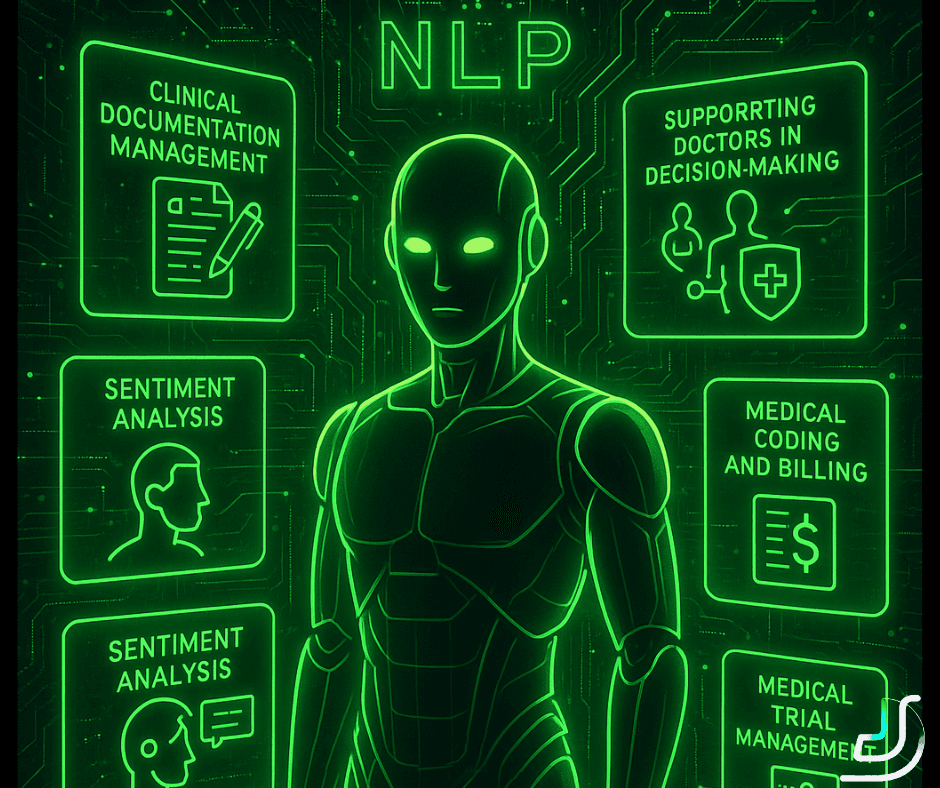
Speech recognition and language processing capture and summarize physician-patient conversations. Adapt to clinical context, reduce errors, produce usable drafts with minimal editing. Direct clinical impact: more patient face time, less after-hours documentation.
Reference deployment: Kaiser Permanente's AI scribe deployment — over 63 weeks, AI scribes supported 2.5M patient encounters, saving 15,000+ hours of documentation time (equivalent to 1,794 full workdays). The pattern that ships: agent generates draft documentation; clinician reviews and signs off. The agent isn't replacing the documentation requirement — it's eliminating most of the typing.
Implementation discipline that separates production from pilot
Five principles from real engagements:
Lay a modular technical foundation
Build the agent system as composable modules — input processing, reasoning, memory, decision-making, user interaction, integration adapters. This lets each component evolve independently. You can upgrade the language understanding module without touching the clinical reasoning logic, swap a third-party API without affecting the audit logging layer.
The 18-month half-life of frontier LLMs means modularity isn't optional. The model you train on today will be eclipsed in 12–18 months. Designs that lock you into a specific model become technical debt fast.
Prioritize data quality, diversity, and HIPAA discipline
Effectiveness hinges on training data. Diverse patient demographics, clinical scenarios, and care settings prevent blind spots and bias. Synthetic data generation helps fill gaps where real data is limited or sensitive — particularly valuable in healthcare where rare conditions and underrepresented populations create coverage problems.
HIPAA discipline is non-negotiable: encryption with customer-managed keys, role-based retrieval access, audit logs joining model output to user identity, immutable storage for compliance review, regular security audits. Skip any of these and the deployment isn't production-grade regardless of how impressive the demos are.
Integrate with existing systems, not against them
Healthcare runs on EHR/EMR systems (Epic, Cerner, Athena), legacy clinical platforms, billing systems, scheduling, telemedicine. Agents that don't integrate cleanly are science projects. Build on FHIR and HL7 standards. Use the EHR vendor's APIs where they exist; build careful adapters where they don't.
Integration alone routinely consumes 25–40% of total project budget on healthcare engagements. Plan for it explicitly during scoping. The "we'll figure out integration later" approach is the most common cost overrun trigger.
Build for production scale, not impressive pilots
Pilots show what's possible. Scaling shows what's actually deployable. The gap between them is enormous in healthcare AI agent projects. Plan for:
- Eval harnesses — golden sets, hallucination metrics, citation accuracy, refusal rate, latency p99 as deployment gates
- Drift detection — production monitoring that catches model behavior change before it reaches patients
- Compliance review cycles — 6–8 weeks of architectural review on average; 12–24 months for SaMD pathway if applicable
- Rollout discipline — one workflow, one department, validated KPIs before scaling
Empower the clinical team, don't replace them
The deployments that succeed treat AI agents as productivity multipliers for clinicians, not replacements. The 70% documentation time reduction Kaiser Permanente reported is meaningful because it gave clinicians their time back, not because it eliminated their role. Frame the deployment around what the agents free clinicians to do, not what they replace.
Change management is the work that converts AI capability into operational value: training, role redefinition, performance metric updates, ongoing feedback loops between operators and the engineering team.
Future outlook
Healthcare AI agents are early in their production journey. The deployments shipping in 2026 are largely augmentation tools — clinical decision support, documentation, monitoring, R&D analysis. Fully autonomous diagnostic or treatment systems aren't coming this year or next; the regulatory pathway, the model accuracy requirements, and the clinical risk model all have to converge first.
What's coming closer to production:
- Multi-modal agents combining imaging, structured EHR data, audio (clinical conversations), and real-time monitoring streams
- Agentic clinical decision support with full citation chains and evidence trails
- Continuous learning systems that improve with deployment data while maintaining regulatory approval
- Cross-system orchestration that spans hospital, payer, and patient-facing workflows
What's further out:
- Autonomous diagnostic systems with full FDA SaMD approval at scale
- Autonomous treatment recommendation in regulated workflows without human review
- Multi-agent systems making coordinated clinical decisions
The teams that succeed in healthcare AI agents over the next decade will be the ones that ship disciplined, augmenting deployments today, build the operational and compliance muscle to scale them, and earn the regulatory acceptance for higher-stakes deployment over time.
FAQs
What's the difference between AI agents and AI chatbots in healthcare? Chatbots respond to prompts and can hold conversation but don't autonomously execute multi-step actions. AI agents take initiative within bounded scope — break tasks into sub-steps, make decisions, execute actions, escalate when they can't proceed. In healthcare, agents are appropriate for workflows; chatbots for simple Q&A.
How accurate are AI diagnostic agents in real settings? Per Microsoft's MAI-DxO benchmarks, diagnostic agents reach 85.5% accuracy on complex cases vs. ~20% for experienced physicians on the same benchmark. But these are research benchmarks, not production-ready autonomous diagnostic systems. Real deployments use agents to expand the clinician's analytical surface, not replace clinical judgment.
Can AI agents fully replace human staff in healthcare? Not in 2026, and probably not in the foreseeable future for clinical decisions. Agents are augmentation tools — they handle routine workflows (documentation, intake, monitoring, R&D analysis) so clinicians can focus on judgment-intensive work. The HITL discipline is what makes deployments compliant and clinically safe.
What's the realistic timeline to ship a healthcare AI agent? PoC: 6–12 weeks at $40K–$80K. MVP: 16–28 weeks. Production with full HIPAA compliance and EHR integration: 32–52 weeks. SaMD pathway adds 12–24 months. Plan in calendar quarters, not sprints.
What's the biggest single source of cost overruns in healthcare AI agent projects? Integration with EHR/EMR systems. Hospital data lives in dozens of legacy systems with inconsistent documentation. Integration cost routinely overruns 30–50% on first-pass scoping. Discovery work upfront prevents most of this.
Ready to scope a healthcare AI agent project? Run the Project Estimator for a deterministic ballpark, or book a 45-minute Discovery with our healthcare AI engineers — we'll review your data, regulatory constraints, and integration surface and tell you honestly which agent workflow is ready for production deployment vs. which to keep in pilot.
Talk to the team behind this
Building something like this in production?
Our senior engineers ship this kind of work for real teams. 45-minute call, no pitch deck — just architecture, trade-offs, and whether we're the right fit for your problem.