
NLP in healthcare: a practical adoption path
Where NLP is genuinely shipping in healthcare today — six production use cases, the implementation discipline that separates production from pilot, and the compliance patterns required for HIPAA-bound deployments.
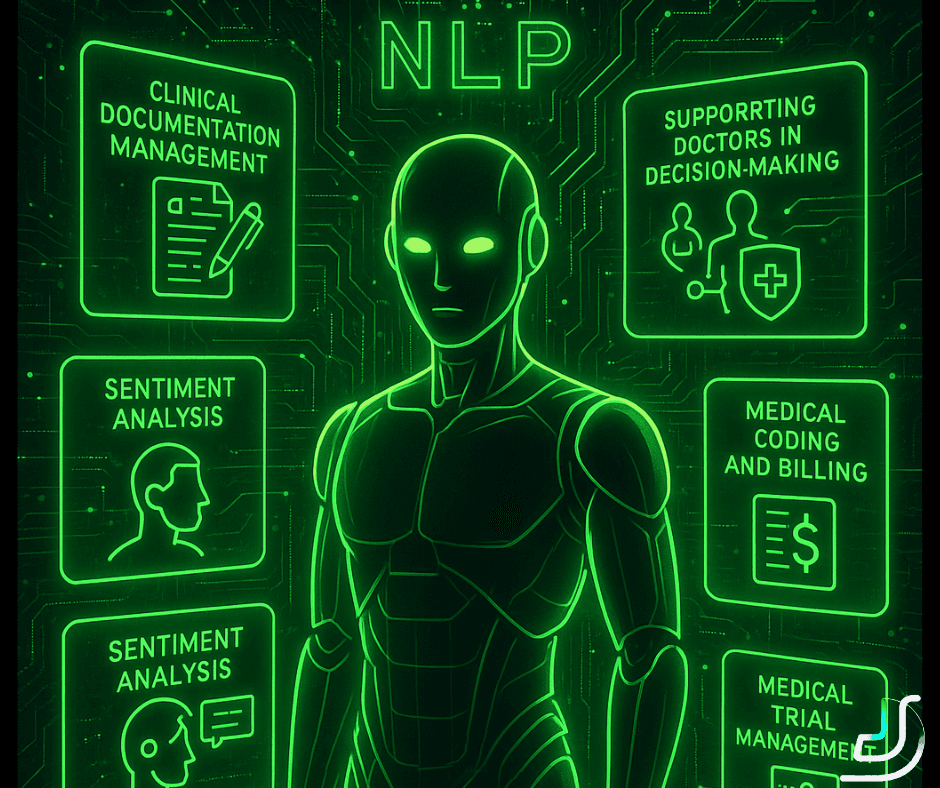
Healthcare data is overwhelmingly unstructured — clinical notes, discharge summaries, imaging reports, patient feedback, regulatory filings, research literature. NLP is the engineering discipline that makes this data analyzable and actionable. Without NLP, 80%+ of healthcare data sits unused; with it, healthcare organizations unlock insights, automate documentation, and improve patient care.
This article maps where NLP is genuinely shipping in healthcare today, the implementation discipline, and the compliance patterns required for HIPAA-bound deployments. For broader healthcare AI framing, see /industries/healthcare and our healthcare AI cost article.
What healthcare NLP actually does
Healthcare NLP processes human language — clinical notes, voice dictations, patient communications, research literature — to extract structured information, identify patterns, and surface insights. Modern healthcare NLP combines:
- Foundation models (BioBERT, ClinicalBERT, PubMedBERT) trained on biomedical text
- General-purpose LLMs (Claude, GPT-4, Gemini) for complex reasoning over medical content
- Domain-specific extraction for medical entities (drugs, diagnoses, procedures, dosages)
- Compliance-aware architecture — HIPAA-grade encryption, audit logging, access controls
The technology is mature; what determines success is implementation discipline.
Six production use cases
1. Clinical documentation and AI scribes
NLP captures physician-patient conversations and generates structured clinical documentation — saving clinicians 1-3 hours per day on note-taking.
Reference: Kaiser Permanente's AI scribe deployment supported 2.5M patient encounters across 63 weeks, saving 15,000+ hours of documentation time.
Impact: clinician burnout reduction, more patient face-time, faster documentation cycle, fewer billing rejections.
2. Clinical decision support
NLP extracts relevant context from patient records, lab results, and imaging reports to surface decision-relevant information for clinicians.
Production patterns: RAG over patient history + clinical guidelines + recent literature, with span-level citations supporting every recommendation. See our RAG for reliable AI article for the architectural patterns.
Impact: reduced missed diagnoses, more comprehensive treatment consideration, evidence-based decision support.
3. Patient communication automation
24/7 patient support handling routine inquiries, appointment scheduling, medication reminders, post-discharge follow-up.
Reference: virtual nursing assistants like Tars Healthcare Advisor AI handle symptom assessment, recommendations, educational content delivery.
Impact: reduced nursing workload, better patient engagement, lower readmission rates.
4. Medical record processing
Extracting structured data from unstructured clinical notes, scanned documents, faxed records — converting them into usable inputs for analytics, research, and AI.
Production patterns: OCR + medical entity recognition + LLM-based extraction for complex documents. Modern multimodal models handle charts and images alongside text.
Impact: unlocks 80%+ of historical clinical data for analysis, accelerates research, improves quality reporting.
5. Insurance and claims processing
NLP automates claims review, prior authorization, fraud detection, eligibility verification.
Production patterns: classifier models for claim categorization + extraction models for clinical context + LLM-based reasoning for edge cases requiring human-readable explanation.
Impact: faster claim processing, reduced denials, fraud loss reduction, lower administrative cost.
6. Research literature mining
NLP processes millions of medical research papers to identify drug-target relationships, clinical trial candidates, treatment patterns, emerging therapies.
Reference: Causaly's agentic AI platform delivers 90% time savings on biomedical literature review.
Impact: faster drug discovery, evidence synthesis, regulatory submissions.
Implementation discipline that separates production from pilot
HIPAA compliance from day one
Patient health information (PHI) requires:
- Encryption at rest and in transit with customer-managed keys
- Role-based access control at retrieval time
- Audit logging joining model output to user identity, timestamp
- Data residency (often on-prem or single-region cloud)
- Business Associate Agreements with all vendors handling PHI
Foundation model APIs (Claude, GPT, Gemini) increasingly offer HIPAA-grade deployment options — Anthropic's Claude Enterprise, Microsoft's Azure OpenAI Service, GCP's Vertex AI all support BAA. For workloads requiring stricter residency, self-hosted options (Llama, Mistral on customer infrastructure) handle the constraint.
Domain-specific accuracy
General-purpose LLMs miss medical terminology, abbreviations, and clinical reasoning patterns. Production NLP combines:
- Domain-specific embeddings (BioBERT, ClinicalBERT) for retrieval
- Foundation models (Claude, GPT-4) for reasoning
- Custom evaluation harnesses with medical-expert-validated golden sets
- Fine-tuning on domain data where accuracy demands it
Citation tracking
Clinical decisions require verifiable sources. RAG with span-level citations is the architecture; pure LLM outputs without grounding aren't deployable for clinical use.
Hallucination mitigation
Confident-but-wrong outputs in clinical contexts are dangerous. Mitigation patterns:
- RAG grounding (model reasons over retrieved context, not training data)
- Refusal templates ("I don't have enough information" preferred over plausible-but-incorrect)
- Output filtering for known failure patterns
- Human-in-the-loop review for any clinical recommendation
Continuous evaluation
Healthcare NLP requires ongoing validation:
- Clinical-expert-validated golden sets
- Hallucination rate tracking
- Citation accuracy metrics
- Bias monitoring across patient demographics
- Drift detection as clinical practice evolves
Adoption path: from pilot to production
A pragmatic 4-stage adoption:
Stage 1: Internal-only pilot (4-8 weeks). Single workflow (clinical documentation, internal Q&A on policies, research literature search). Internal users, no patient-facing exposure. Validate NLP feasibility on real data, surface integration risks.
Stage 2: HITL-gated production (12-20 weeks). Same workflow, broader user base, clinician-in-the-loop for any patient-facing output. Establish quality metrics, monitoring, governance.
Stage 3: Selective autonomy (16-24 weeks). Clinician oversight for high-stakes outputs, automated handling for low-risk routine outputs. Continuous quality monitoring, periodic review.
Stage 4: Enterprise deployment (32+ weeks). Multi-workflow rollout, integrated MLOps, comprehensive governance, board-level oversight.
Most successful healthcare NLP deployments take 9-18 months from initial pilot to enterprise production. Compressing the timeline below this threshold consistently produces failures — usually traced to inadequate clinical validation, compliance gaps, or change management failures.
Three deployment scenarios
Small healthcare org NLP: Clinical documentation assistance, single specialty, basic compliance. $80K-$200K initial + $40K-$100K/year.
Mid-size health system: Multi-specialty NLP with clinical decision support, EHR integration, full HIPAA compliance. $300K-$800K initial + $200K-$400K/year.
Enterprise healthcare platform: Comprehensive NLP across documentation, decision support, research, claims processing. Multi-jurisdiction compliance. $800K-$2M+ initial + $500K-$1M+/year.
Final framing
Healthcare NLP is mature, deployable, and shipping at scale. The teams that succeed treat it as engineering discipline: HIPAA-compliant architecture from day one, domain-specific accuracy, citation tracking, hallucination mitigation, continuous evaluation. The teams that try shortcuts produce pilots that don't reach production.
The competitive advantage compounds. Healthcare organizations deploying NLP thoughtfully today are building the operational infrastructure for AI-augmented care that will dominate the next decade.
Ready to scope a healthcare NLP project? Run the Project Estimator for a deterministic ballpark, or book a 45-minute Discovery with our healthcare AI engineers — we'll review your clinical data, integration requirements, and compliance posture, and tell you honestly which NLP use case is ready for production deployment.
Talk to the team behind this
Building something like this in production?
Our senior engineers ship this kind of work for real teams. 45-minute call, no pitch deck — just architecture, trade-offs, and whether we're the right fit for your problem.