
How much does AI cost in 2026? Well, it depends
Honest engineering breakdown of what AI projects actually cost in 2026. Five factors that move the price, three real engagements with cost ranges, and how to scope without overpaying.
"How much does AI cost?" is a question with no honest single answer — but five factors explain almost every cost gap we see between engagements. Get them right and the budget converges on a defensible number. Get any one wrong and you're either underbuilding for the actual workload or paying for capability that doesn't materialize.
The honest baseline: most custom AI MVPs land in the $40K–$150K range for the AI components themselves, with surrounding software (web, mobile, cloud, embedded) billed separately. Smaller experiments are possible — a PoC validating feasibility runs $15K–$40K — but anything below that line is rarely production-ready and frequently turns into a "we proved nothing" outcome that wastes the budget without producing a path forward.
This article maps the factors that actually move AI project costs in 2026, with cost ranges from real engagements and a reduction playbook that covers what the original ITRex generic-cost-guide template never did. For more granular breakdowns by AI subtype, see how much does AI agent development cost and calculating the cost of generative AI.
Five factors that move AI project cost
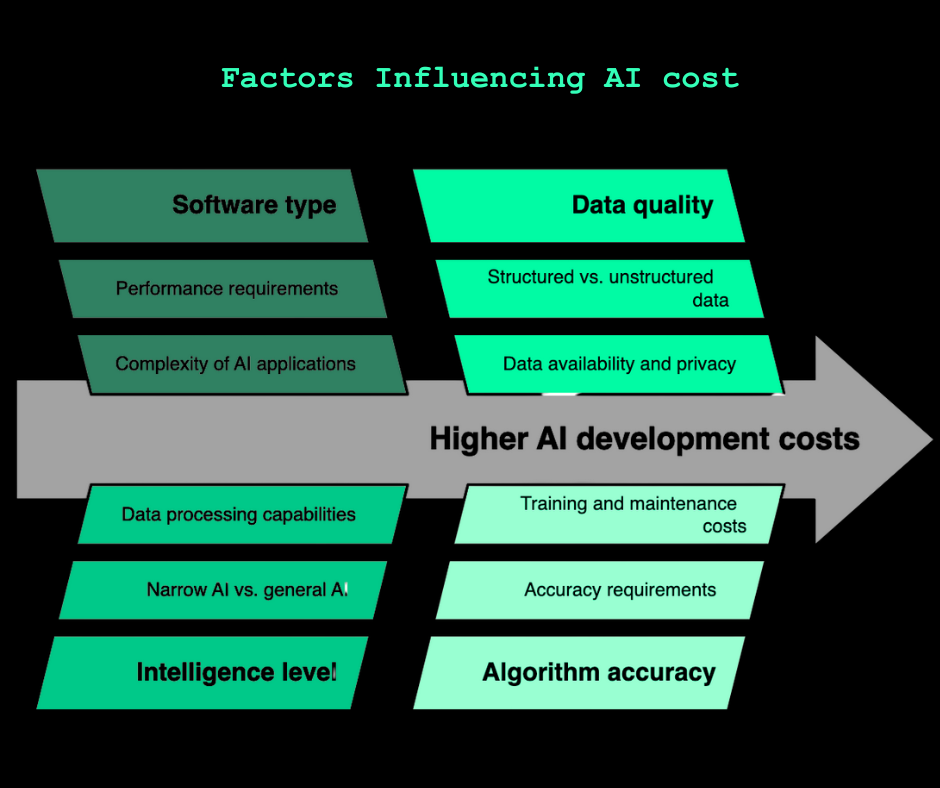
1. Type of AI you're building. "AI" covers everything from a deterministic decision tree to an autonomous multi-agent system. The complexity gap between them is two orders of magnitude in cost. A voice assistant for a narrow workflow, a security camera with face recognition, an expert system flagging tumors in CT scans — all "AI" — but they vary 10–100× in implementation cost based on architecture, data requirements, and accuracy targets. The first scoping question on every engagement is what kind of AI is actually required to solve the problem, not what kind of AI sounds impressive.
2. Level of intelligence required. Most production AI is narrow — programmed for a specific task (text extraction, fraud detection, sentiment scoring). Truly general intelligence is decades and billions away from where the budget can reach. Be honest about which level your workload actually needs. A narrow ML classifier solves 80% of business problems for 10% of the cost of a generative AI agent built for the same outcome. The pattern we see most often: teams scope for autonomous reasoning when fixed logic plus a fine-tuned classifier would have shipped in half the time at a fraction of the cost.
3. Volume and quality of training data. AI is only as good as the data it learns from, and data preparation routinely consumes 25–30% of total project budget. Structured data (RDBMS records, labeled examples) is cheaper to work with. Unstructured data (emails, scanned PDFs, images, videos) requires preprocessing pipelines, labeling, and storage that adds materially to cost. In regulated industries (healthcare, finance, government), data acquisition itself is constrained by privacy and security — synthetic data generation, federated learning, or careful data sharing agreements may be necessary, each with its own cost. The shortcut: workloads where you already have clean labeled data run 30–50% cheaper than equivalent workloads where data prep is on the critical path.
4. Accuracy target. Accuracy isn't free. A customer support chatbot that handles 60% of routine queries with humans on the other end is a different build from a delivery drone whose computer vision must be near-perfect. Higher accuracy targets demand more training data, more fine-tuning iterations, more eval harness investment, and more compliance overhead. They also extend project timelines — model accuracy improvement scales roughly logarithmically, so the last few percentage points cost more than the first 80%. Be specific about what accuracy you actually need, and what failure mode is acceptable.
5. System complexity beyond the model. Production AI is more than a model — it's the cloud infrastructure, ETL/streaming pipelines, internal/external APIs, user interface (web dashboard, mobile app, voice assistant), authentication, authorization, observability, audit logging. The "AI" portion is often 20–30% of total project cost; the rest is platform engineering. A lightweight chatbot inside a corporate messenger has minimal infrastructure footprint. An AI-powered data ecosystem providing a 360-degree view across enterprise systems is a different category of build entirely. Be clear which one you're scoping.
A separate framing worth knowing: only ~20% of enterprise AI projects make it from prototype to production, per Gartner data. The reasons aren't usually technical — they're project structure failures: poor collaboration between data scientists and software engineers, low-quality training data, no company-wide data strategy, unrealistic "moonshot" scoping that runs out of budget before delivering value. Understanding why projects fail saves more money than any cost reduction tactic.
Three real engagements
To anchor the abstractions, three real JustSoftLab projects with the cost ranges they actually came in at.
Project 1: AI-powered telemedicine platform
A healthcare technology company partnered with us to upgrade a telehealth system deployed across multiple US hospitals with video recording capabilities. The new version would let clinicians apply face recognition and natural language processing to consultation videos to detect changes in communication style — a signal that may indicate patient well-being shifts and inform treatment plans.

During discovery we ruled out technology barriers and selected the stack — Python plus speech recognition and analysis frameworks. The pilot scope was limited to speech-to-text functionality with no user-facing components yet, just the linguistic-analysis pipeline that processes video recordings and surfaces communication-style indicators for physicians.
Cost range for a basic video/speech analysis AI platform: $40K–$60K.
Project 2: AI-powered recommendation engine
A founder building a B2C platform connecting users with local service providers wanted to replace cumbersome search filters with ML-driven recommendations that interpret natural-language queries and return matching providers.

We built on Amazon Personalize as the ML engine, with a Python back end and user data stored in S3. The platform delivers personalized recommendations from text queries, with managed cloud infrastructure for training, deploying, and hosting the models — useful when the founder doesn't have an ML team in-house and wants to keep operational complexity low.
Cost range for an MVP recommendation engine: $25K–$40K.
Project 3: GenAI-powered art generator
A visual artist commissioned us to build a generative AI solution that produces new paintings inspired by his work and the work of other artists he admires. Goal: present the system at an upcoming exhibition within several weeks.

We built a neural network on PyTorch and TensorFlow that processes abstract paintings, learns the artist's signature style, generates similar pieces, and displays them on his website. For the MVP we used 1024×1024 image resolution and deployed locally, with the option to migrate to cloud later as the system gained traction.
Cost range for an MVP-scale generative art platform: $20K–$40K depending on training data type (abstract vs. figurative), output resolution (HD vs. low), and deployment approach (local vs. cloud).
These three engagements aren't outliers — they're representative of how cost ranges form in real projects. The architecture, data quality, accuracy target, and system surrounding the model determine where in the range the final number lands.
How to scope AI without overpaying
A Forbes Technology Council piece notes that AI projects routinely cost 15× more than initial estimates — usually because of underestimated data integration, infrastructure optimization, and ongoing AI management overhead. We see the same pattern across engagements where teams skip the disciplined scoping work and start building.
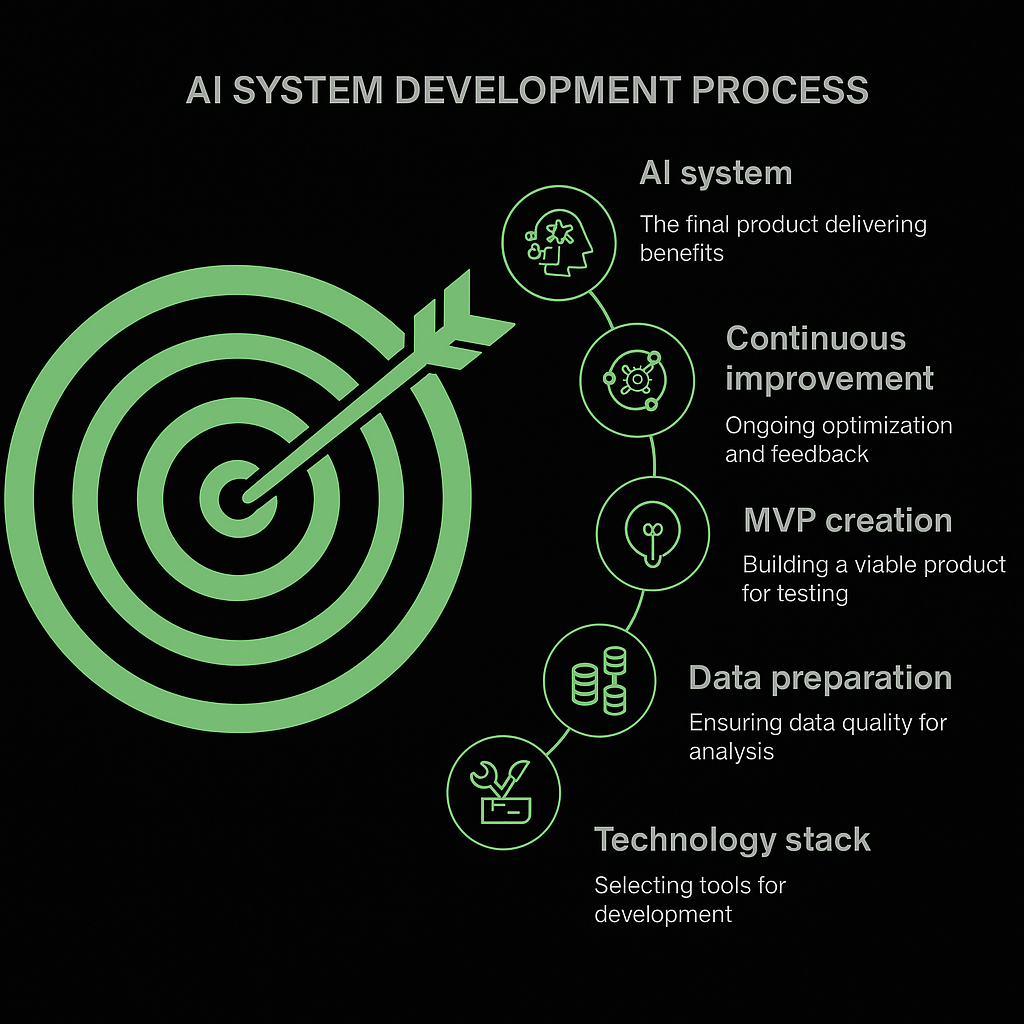
The six-step playbook we run on real engagements:
1. Collect stakeholder feedback. Before any architecture decision, identify the workflows and decision flows that AI could realistically supplement or automate. Interview the people who do the work today, not just the executives sponsoring the project. The ground truth is in the operators.
2. Prioritize the use cases that matter. Apply a product prioritization framework (MoSCoW, RICE, Kano) to pick the workloads that deliver the highest value during the pilot and serve as a foundation for further rollout. The most common scoping mistake is trying to ship 10 use cases at once. Pick one. Ship it. Learn. Then expand.
3. Pick a vendor-agnostic stack. Combine custom-built, open-source, and off-the-shelf components instead of locking into one vendor's ecosystem. Plug-and-play face recognition, API-driven voice models, cloud ML services where appropriate, custom code where it's the differentiator. UI/UX matters disproportionately for AI products — most failures we see involve interfaces that don't expose the AI's confidence or fallbacks gracefully.
4. Prepare data before training. Data preparation is where the budget either holds or explodes. Spend the time to gather, normalize, deduplicate, label, and validate data quality before model selection. Synthetic data generation is increasingly viable for filling gaps without expanding labeling payroll. Identifying the right data and preparing it well is the single highest-leverage cost-control move on any AI project.
5. Build an MVP, not a moonshot. A minimum viable product validates the concept on real data, identifies algorithm improvement areas, and creates a launch point for scaling. Don't confuse an MVP with a proof of concept — a PoC validates feasibility on internal data; an MVP ships to real users at limited scope. For most enterprise AI projects, sequencing PoC → MVP → production deployment cuts total cost 30–40% vs. trying to ship a full system on first pass.
6. Treat the system as a learning workflow. AI doesn't deliver perfect results from day one. As the system processes real data under human supervision, predictions improve and autonomy grows. Continuous feedback collection, retraining cycles, and iterative improvement are part of the operating cost — budget 15–20% of initial development annually for these activities. Skipping this is the most expensive false economy in AI operations.
For deeper treatment of the scoping process and where teams underspend or overspend, see our companion article on generative AI cost economics.
Cost reduction tactics that actually work
Beyond the scoping playbook, four tactics that consistently move the AI project budget down without compromising outcomes:
Pre-trained foundation models over from-scratch training. A custom-trained foundation model is a $100M+ exercise reserved for foundation labs. Use existing models (Claude, GPT, Llama, Mistral, Gemini) as the starting point. Fine-tune the embedding model for domain vocabulary if accuracy demands it. Layer RAG for current grounded knowledge. The cost gap between this approach and from-scratch training is two orders of magnitude.
Synthetic data over manual labeling. For tasks where real-world labeled data is scarce or sensitive, synthetic data generation via foundation models can fill 60–80% of the gap at a fraction of the cost. The remaining real-world examples can validate quality. Combined with semi-supervised learning, this can cut data preparation cost 50% or more on regulated workloads.
Spot Instances and reserved capacity. Cloud GPU spend is the line item that grows fastest in production AI. Spot Instances for batch and flexible workloads cut up to 90% of GPU cost. Reserved Instances or Committed Use Discounts for predictable inference workloads cut another 30–60%. The mix can reduce total infrastructure spend up to 75% without performance impact.
Modular architecture for vendor portability. Build pipelines, APIs, and microservices that can be reconfigured without rip-and-replace as the AI landscape shifts. The 18-month half-life of frontier models makes vendor lock-in expensive. The modularity tax is small at build time, large at year-2 retraining cycles when you want to swap models.
In the end, what should you actually budget?
Most custom AI MVPs land in the $40K–$150K range. PoCs run $15K–$40K. Enterprise-scale autonomous systems with regulatory load run $200K–$1M+. Year-2 maintenance is 15–20% of initial development annually. These are honest ranges based on the engagements we ship — your specific project will land somewhere in here based on the five factors above.
The competitive context: PwC projects AI could contribute up to $15.7 trillion to the global economy by 2030. The advantage isn't going to companies that spent the most. It's going to companies that scoped well, shipped early MVPs, learned from production data, and iterated. The cost of building AI well is much lower than the cost of building it badly — but both options are achievable from the same starting budget.
FAQs
How do I align AI initiatives with my company's overall business strategy? Define measurable objectives and KPIs that link AI projects directly to business outcomes — revenue, cost reduction, customer satisfaction, time-to-market. Avoid the "let's add AI" trap where projects start as technology in search of a problem. Every AI investment should have a defined outcome and a way to measure whether the investment achieved it.
What organizational changes support AI adoption? Training staff to work alongside AI, fostering literacy in AI capabilities and limitations, and addressing resistance to change directly. The technology is rarely the bottleneck. The organizational adaptation — workflows, responsibilities, decision rights — is where AI projects most often stall.
How do we select the right AI vendor or partner? Technical expertise, industry experience, and the ability to understand your business challenges in concrete terms. Review portfolios, get client references, and start with a small pilot or workshop to assess fit before committing to a multi-quarter engagement. The right partner pushes back on scoping decisions when they don't make sense — not just executes whatever you brief.
What's the realistic timeline from PoC to production AI? For typical custom AI projects: 4–8 weeks for PoC validation, 12–24 weeks for MVP, 24–52 weeks for production deployment with monitoring and scale-out. Regulated industries (healthcare, finance) add 8–16 weeks for compliance review. Plan in calendar quarters, not weeks.
Ready to scope an AI project? Run the Project Estimator for a deterministic ballpark, or book a 45-minute Discovery with our AI engineers — we'll help you scope what level of AI your workload actually needs, what cost range to plan for, and what's realistic in your timeline.
Talk to the team behind this
Building something like this in production?
Our senior engineers ship this kind of work for real teams. 45-minute call, no pitch deck — just architecture, trade-offs, and whether we're the right fit for your problem.