
How to implement AI in business: a practical engineering guide
What separates companies capturing real value from AI from those running expensive pilots — five steps that consistently produce shipping deployments, with the discipline that makes ROI measurable.

Most enterprise AI implementations fail to capture the projected value. McKinsey research shows roughly 20% of AI projects deliver expected ROI; the rest stall in pilot, ship without measurable outcomes, or overrun budget without producing operational change. The gap between AI Leaders and AI Laggards isn't technology — it's implementation discipline. Leaders treat AI as an operating capability with measurable ROI; laggards treat it as a pilot project with vague success criteria.
This article maps the five-step process that consistently produces shipping AI deployments — based on engagements across healthcare, finance, manufacturing, retail, and energy. For broader cost framing, see our how much does AI cost in 2026 and calculating machine learning costs articles.
What separates AI leaders from laggards
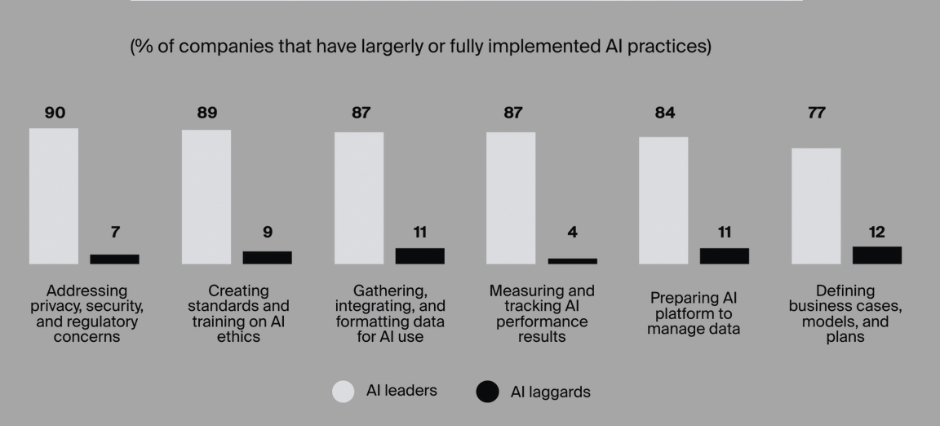
Five characteristics consistently differentiate companies capturing AI value from those that aren't:
- Clear scoping. Specific workflows with measurable cost or revenue baselines, not "let's add AI"
- Data foundation built first. Clean data infrastructure precedes ML deployment, not vice versa
- Production discipline. MLOps, monitoring, retraining cycles built into the operating model
- Walk-away discipline. Pilots that don't hit success criteria get shut down, not "rescued"
- Compound investment. AI capabilities compound — successful narrow deployments build the foundation for broader ones
The companies leading in their industries by 2027 will be the ones investing in this discipline now.
A five-step implementation framework
Step 1: Understand AI's capabilities and limitations
Before scoping any AI project, executives need realistic expectations of what AI can and can't do. The honest framing for 2026:
What AI does well:
- Pattern recognition in large datasets (anomaly detection, classification, clustering)
- Document and image processing at scale
- Natural language understanding and generation in bounded contexts
- Optimization across many variables (routing, scheduling, allocation)
- Personalization based on behavioral signals
- Predictive maintenance from sensor data
- Real-time inference on bounded tasks
What AI struggles with (in 2026, even with frontier models):
- Genuinely novel reasoning outside training distribution
- Long-horizon planning with multi-month consequences
- Tasks requiring deep contextual judgment about edge cases
- Open-ended creative work that requires originality (vs. competent recombination)
- Decisions where the cost of confident-wrong is high without HITL gates
The single most common AI implementation failure: scoping the project for capabilities AI doesn't actually have, then scrambling to redefine success when reality intrudes. Realistic capability assessment upfront prevents the most expensive scoping mistakes.
For deeper treatment of specific AI subfields and their maturity, see GenAI trends for C-level executives, what are AI agents, and computer vision applications across industries.
Step 2: Define goals with measurable financial outcomes
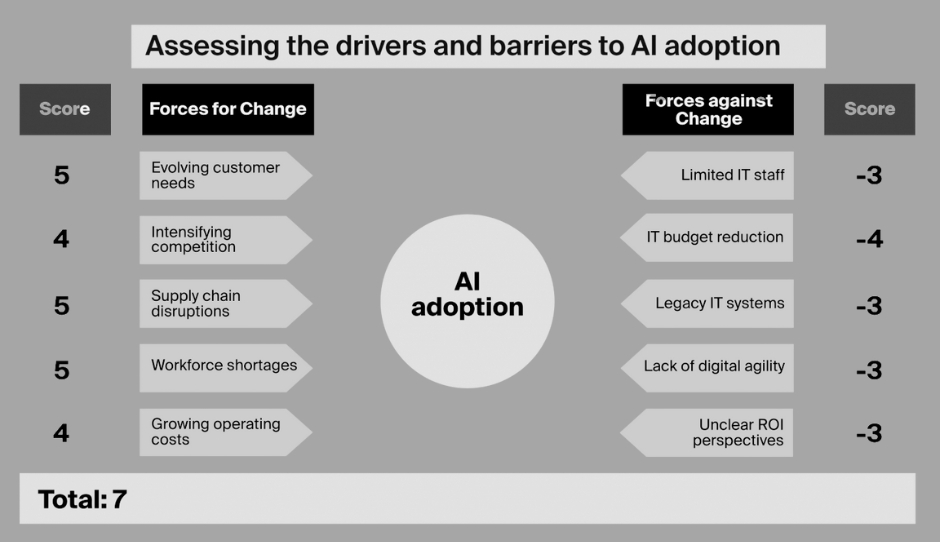
The discipline that separates shipping projects from stalled pilots: specific financial targets with clean baselines.
Wrong: "Reduce costs through AI." Right: "Reduce per-document invoice processing cost from $4.20 to $1.50 by Q3, validated against our finance system's cost-per-document metric."
Wrong: "Improve customer experience." Right: "Reduce customer support ticket resolution time from 18 hours to 4 hours, measured by ticket close timestamp; target 35% deflection rate on Tier 1 queries."
The work to establish baseline metrics is part of the AI investment, not optional. Skip it and you can't measure success or failure.
Five categories of measurable AI goals that consistently work:
- Direct cost reduction (labor, infrastructure, supplier expenses)
- Throughput improvement (cases per hour, transactions per second, products per shift)
- Quality improvement (defect rates, error rates, accuracy on bounded tasks)
- Revenue uplift (conversion rate, basket size, retention rate)
- Time-to-decision (cycle time on key business processes)
Match the goal to your highest-leverage business metric, with a specific number target.
Step 3: Evaluate AI readiness honestly
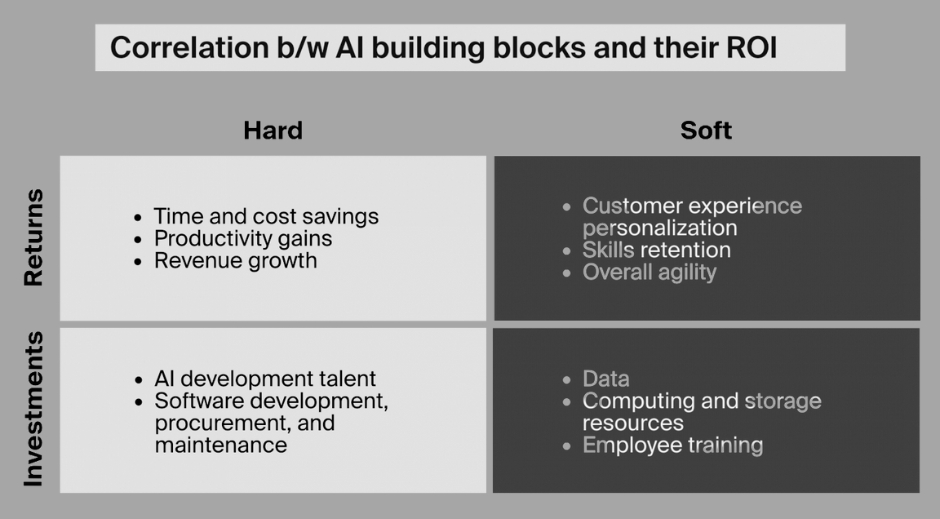
Five readiness markers that determine whether AI investment will pay back:
1. Data readiness. Is the data needed to train and operate the AI clean, accessible, and compliant? Most enterprises have data quality issues that block AI deployment. The work to address these is part of the AI investment, but it's also a prerequisite. For deeper treatment, see /services/data-engineering.
2. MLOps capability. Does the team have the skills to deploy, monitor, retrain, and govern ML models in production? If not, partner with a delivery team that has these skills, with knowledge transfer to internal teams over time.
3. Executive sponsorship. Is there an executive who will own outcomes, not just provide budget? Projects without genuine executive ownership stall when difficulties emerge in execution.
4. Walk-away discipline. Is the organization willing to shut down AI projects that don't hit success criteria? Without this, failed pilots accumulate sunk cost and organizational confusion.
5. Compound investment commitment. Will the organization fund ongoing operational discipline (MLOps, monitoring, retraining) or treat AI as a one-time build? AI as one-time project doesn't deliver compounding value.
Missing any of these markers is a yellow flag. Address them before committing capital, not as part of the AI build.
Step 4: Integrate selectively, plan for scale
The pragmatic path: start with one workflow, ship to real users at limited scope, validate success metrics, then expand based on data.
MVP scoping discipline:
- One specific workflow, not five
- Bounded user population (one department, one product line, one geography)
- Clear success metrics defined upfront
- Limited integration surface (one or two existing systems)
- 12–24 weeks build timeline, not 12 months
The MVP either hits the success metrics or it doesn't. If it does — scale to adjacent workflows. If not — diagnose root cause (data quality, model accuracy, integration, change management) and either fix or shut down.
Scaling pattern that works:
- MVP at one workflow validates the pattern
- Adjacent workflow expansion validates generalization
- Multi-workflow platform investment validates compound benefits
- Enterprise-wide AI capability becomes operating model rather than project portfolio
Most AI projects that succeed at scale started with disciplined MVP scoping. Most that fail tried to deploy enterprise-wide AI on first pass.
Step 5: Achieve operational excellence
The work that compounds AI value over years:
MLOps infrastructure. Model versioning, automated training pipelines, deployment automation, monitoring, alerting, drift detection. Not optional for production AI — see our MLOps capability page.
Continuous training and retraining. Models drift as data and behavior shift. Build retraining cycles into the operating cadence, not as one-off projects.
Governance frameworks. AI risk taxonomies, model risk management, ongoing monitoring, incident response. Required for regulated industries; valuable everywhere.
Bias and fairness monitoring. Continuous monitoring across protected classes, especially for regulated workflows (lending, hiring, healthcare, criminal justice).
Performance optimization. Model distillation, quantization, infrastructure right-sizing as deployment scales. Production AI cost grows nonlinearly without optimization discipline.
Compound capability investment. Each successful AI deployment creates infrastructure, data assets, and operational expertise that accelerates the next. Treat AI as compounding investment, not project portfolio.
Five common AI implementation FAQs
How do I calculate total cost of AI implementation beyond development?
Five categories beyond initial development:
- Data infrastructure — data engineering work that often precedes AI investment
- MLOps infrastructure — deployment, monitoring, retraining, governance ($30K–$100K+ initial)
- Year-2 maintenance — 15–20% of initial development cost annually for retraining, drift correction, infrastructure updates
- Compliance and governance — audit, security review, legal review (more for regulated industries)
- Change management — training, role redefinition, workflow adaptation
The headline development cost is typically 40–60% of total cost over 3 years. Plan for the rest.
For broader cost framing, see calculating the cost of generative AI and how much does AI cost in 2026.
How do businesses ensure AI models remain unbiased and ethical?
Six practices that work in production:
- Diverse training data with explicit fairness validation across protected classes
- Bias audits at deployment and on an ongoing schedule
- Output filtering for explicit bias patterns
- Explainability layers (Grad-CAM, LIME, SHAP, attention visualization) where decisions affect customers
- Continuous fairness monitoring in production
- Independent ethics review for high-stakes applications (lending, hiring, healthcare, criminal justice)
Treat AI ethics as an engineering discipline with ongoing operational requirements, not a one-time policy review.
What are the security risks of AI, and how do we mitigate them?
Seven categories of AI-specific security concerns:
- Data exfiltration through model output (PII inference attacks)
- Prompt injection in LLM-based systems
- Model tampering in deployed systems
- Adversarial attacks on classifiers (subtle input modifications causing misclassification)
- Training data poisoning in continuously-learning systems
- Privilege escalation through agent action capabilities
- Compliance violations through unintended data handling
Mitigation patterns: encryption at rest and in transit, role-based access control, prompt and output filtering, model integrity verification, adversarial robustness testing, secure deployment pipelines, ongoing security audits.
For deeper treatment of compliance patterns specifically in regulated AI workloads, see /fintech/rag and 10 RAG architecture mistakes.
How do we integrate AI into legacy systems without disruption?
Three patterns that work:
- API gateway pattern. AI sits behind an API; legacy systems consume AI capabilities through standard interfaces. Loose coupling, easy to swap models, easy to roll back.
- Middleware integration. AI runs in parallel with legacy systems, with middleware coordinating data flow. Useful when legacy systems can't be modified directly.
- Gradual replacement. AI handles new traffic; legacy continues handling existing traffic. Migration happens over months as confidence builds.
For comprehensive treatment of legacy integration in fintech specifically (where COBOL still supports 80% of credit card activity), see our GenAI in finance and GenAI in banking articles.
What are the biggest misconceptions about AI implementation?
Five myths we encounter most often:
-
"AI will replace the workforce." Reality: AI augments most workflows; full replacement is rare and usually inappropriate. The companies winning treat AI as productivity multiplier, not workforce reduction tool.
-
"AI deployments are quick to ROI." Reality: most production AI shows negative ROI for the first 6–12 months as infrastructure stabilizes and adoption ramps. Plan capital for 18 months, not 6.
-
"More data always equals better AI." Reality: data quality matters more than quantity. Clean small datasets often outperform noisy large ones. Data preparation discipline is the highest-leverage investment.
-
"AI is plug-and-play." Reality: production AI requires significant integration, customization, and operational maintenance. Off-the-shelf solutions work for narrow use cases but rarely capture the full value of AI.
-
"AI ethics is a policy review." Reality: AI ethics is an engineering discipline with ongoing operational requirements. Bias monitoring, fairness audits, explainability — all production engineering work.
Closing thoughts
AI implementation in business is neither magic nor straightforward — it's disciplined engineering work with clear patterns that work and clear failure modes to plan for. The companies capturing AI value are deploying it the way they deploy other strategic infrastructure: with executive ownership, clear success metrics, operational discipline, and compound investment over years.
The AI capabilities of 2026 are real and substantial. The competitive advantage compounds over time. But the value isn't captured by enthusiasm — it's captured by execution. Match the implementation discipline above to your specific business priorities, scope deliberately, and ship in stages.
Ready to scope an AI implementation project? Run the Project Estimator for a deterministic ballpark, or book a 45-minute Discovery with our AI engineers — we'll review your priorities, validate AI readiness, and tell you honestly which workflows are ready for production deployment.
Talk to the team behind this
Building something like this in production?
Our senior engineers ship this kind of work for real teams. 45-minute call, no pitch deck — just architecture, trade-offs, and whether we're the right fit for your problem.